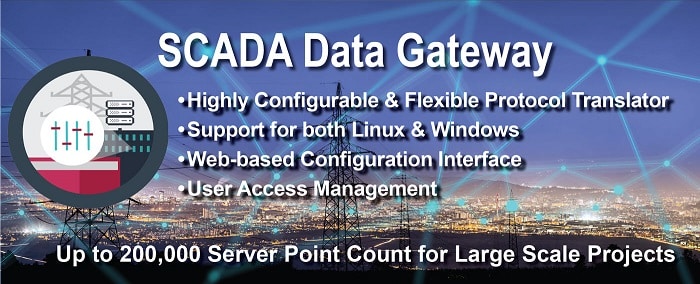
What Is the SCADA Data Gateway?
The SCADA Data Gateway (SDG) is a software application developed by Triangle MicroWorks, Inc. (USA, established 1994) that functions as a multi-protocol translator, OPC server, and data concentrator for power utility and industrial SCADA systems. It collects data from devices using one set of protocols and re-publishes that data to other systems using entirely different protocols — bridging the communication gaps that exist between heterogeneous control system architectures.
Triangle MicroWorks has been developing SCADA communication protocol tools since 1994 and serves customers in more than 70 countries across power, water, oil & gas, and industrial automation sectors. The SCADA Data Gateway has accumulated over 20 years of field deployment history, making it one of the most proven protocol gateway applications available for utility-grade applications.
Current version: v5.1, available for both Windows and Linux, featuring a redesigned web-based user interface with user management and role-based access control.
The SDG is used by:
- System integrators building SCADA systems that must interoperate with diverse field devices and external control centers
- Electric utilities integrating IEC 61850 substations with legacy SCADA masters
- Energy management centers exchanging data with neighboring control centers via ICCP/TASE.2
- Water and gas utilities translating between DNP3 RTUs and OPC-based SCADA platforms
- Industrial automation teams bridging Modbus equipment into IEC 61850 or OPC UA architectures
The Problem SDG Solves
Modern power and utility control systems are built on a patchwork of communication protocols that evolved independently over decades:
- Legacy RTUs communicate via DNP3 or IEC 60870-5-101/104
- Modern IEC 61850 substations use MMS and GOOSE
- SCADA software reads data through OPC DA or OPC UA servers
- Control centers exchange data with neighboring systems via ICCP/TASE.2
- Industrial field devices use Modbus TCP or Modbus RTU
Without a protocol gateway, connecting these diverse systems requires either deploying multiple specialized software components (one per protocol pair) or replacing legacy equipment entirely — both expensive and disruptive approaches.
The SCADA Data Gateway handles this translation centrally: configure connections to any number of source protocols, define point mappings, and the SDG continuously translates and republishes data to any number of destination protocols in real time — on a single Windows or Linux server.
Supported Protocols
The SDG supports bidirectional operation in all major SCADA communication protocols, acting as both server (responding to client requests) and client (polling or subscribing to data):
As Data Source (Client/Master — collecting data from field devices or external systems)
- OPC DA (client) — read from any OPC DA server
- OPC UA (client) — subscribe to OPC UA servers
- IEC 60870-5-101 (master) — serial telecontrol
- IEC 60870-5-104 (master) — TCP/IP telecontrol
- DNP3 LAN/WAN (master) — DNP3 over Ethernet
- DNP3 Serial (master) — DNP3 over RS-232/RS-485
- IEC 61850 MMS (client) — read from substation IEDs via MMS reports and polling
- IEC 61850 GOOSE (subscriber) — subscribe to GOOSE multicast messages
- IEC 60870-6 TASE.2/ICCP (client) — receive data from other control centers
- Modbus TCP (master) — read from Modbus TCP devices
- Modbus Serial RTU/ASCII (master) — read from serial Modbus devices
- ODBC (client) — read from SQL databases
As Data Destination (Server/Slave — supplying data to SCADA, HMI, or other systems)
- OPC DA (server) — present data to any OPC DA client (SCADA, historian, HMI)
- OPC UA (server) — present data to OPC UA clients with full security
- IEC 60870-5-101 (controlled station) — respond to SCADA master polling
- IEC 60870-5-104 (controlled station) — respond to SCADA master over TCP/IP
- DNP3 LAN/WAN (outstation) — respond to DNP3 master
- DNP3 Serial (outstation) — respond to DNP3 master over serial
- IEC 60870-6 TASE.2/ICCP (server) — supply data to other control centers
- Modbus TCP (slave) — respond to Modbus TCP masters
- Modbus Serial RTU/ASCII (slave) — respond to serial Modbus masters
This bidirectionality means the SDG can simultaneously act as a master (collecting from field devices) and as a slave (serving the SCADA above) — bridging the two directions in real time.
Core Features
Multi-Protocol Point Mapping
The fundamental capability of SDG: mapping data points from source protocols to destination protocols. The mapping engine supports:
- Master-to-Slave mapping — most common pattern: collect from field devices (master/client role) and serve to SCADA (slave/server role)
- Two-Master mapping — collect from two different source systems and consolidate
- Two-Slave mapping — serve the same data to two different destination systems simultaneously
- Data type translation — translate between different point types (e.g., DNP3 Binary Input → IEC 60870-5-104 Single-Point Information, or IEC 61850 BOOLEAN → Modbus Coil)
- Control method translation — translate commands between protocol-specific control types (e.g., DNP3 CROB → IEC 60870-5-104 Double Command, or IEC 61850 SBO → DNP3 Direct Operate)
- Up to 200,000 server points — supports large-scale utility deployments with extensive point databases
Equation Editor
A built-in computation engine allowing creation of derived data points from raw measured values:
- Arithmetic operations: add, subtract, multiply, divide raw point values
- Logical operations: AND, OR, NOT combinations of binary inputs
- Comparison operators: create alarm points from threshold comparisons
- Statistical functions: average, minimum, maximum over time windows
- countchange() function: count transitions of a binary input — useful for event counting
- Equation points can reference other equation points (chained calculations)
- Equation-based points appear as normal data points to downstream SCADA clients — no special handling required
Use cases:
- Calculate MW total from multiple feeders
- Convert raw 4-20mA register to engineering units (temperature, pressure, flow)
- Combine two single-point signals into a double-point indication
- Compute transformer loading percentage from kV and kA measurements
Sequence of Events (SOE) Logging
Time-stamped event logging for compliance and post-incident analysis:
- Selective event logging — configure which points are recorded to the SOE log
- Millisecond-resolution timestamps — from IED timestamps where available
- Log file output — plain text files for integration with event analysis tools
- Events include: point name, value change, timestamp, quality flags
- SOE log can be monitored by external applications for real-time event processing
Report by Exception (RBE)
Bandwidth optimization critical for wide-area communication links:
- Configure points to report only when their value changes (exceeds dead-band or changes state)
- Dramatically reduces traffic on bandwidth-constrained channels (radio, cellular, satellite)
- Particularly important for IEC 60870-5-101 serial connections and DNP3 unsolicited reporting
Protocol Analyzer (Built-in)
A packet-level communication monitoring tool integrated directly into the SDG:
- Capture and display raw protocol frames for all active connections
- Decode frames at the protocol field level — see every ASDU, data type, address, and value
- Filter by connection, point address, or message type
- Essential for debugging communication issues without external packet capture tools
OPC UA Server with Security
The SDG’s OPC UA server implementation includes full security features:
- Application certificates — X.509 certificate authentication
- User authentication — username/password and certificate-based user access
- Transport security — configurable security modes (None, Sign, Sign & Encrypt)
- Security policies — Basic128Rsa15, Basic256, Basic256Sha256
- GUI-based certificate management in the web interface
IEC 61850 Integration
One of SDG’s most powerful capabilities — translating between IEC 61850 and traditional SCADA protocols:
- MMS client — read data from IEC 61850 IEDs using BRCB/URCB reports and polling
- GOOSE subscriber — receive protection signals and status from GOOSE publishers
- SCL file support — import IED configuration from SCD/ICD files to auto-configure point lists
- Direct translation — translate IEC 61850 directly to DNP3, IEC 60870-5, Modbus, OPC without intermediate OPC drivers
- IEC 61850 Edition 1 and 2 support
- IEC 62351 security — secure authentication, role-based access, TLS encryption
- IEC 61850-7-410 (Hydro), -7-420 (DER), and IEC 61400-25 (Wind) profile support
DNP3 Secure Authentication
For deployments requiring IEC 62351-compliant DNP3 security:
- Challenge-response authentication per IEC 62351-5
- Prevents unauthorized commands and data injection
- Compatible with SAv2 and SAv5 implementations
- Configurable per-channel and per-point security requirements
IEC 60870-5 Secure Authentication
Extends security to IEC 60870-5-101 and IEC 60870-5-104:
- Based on IEC 62351 Parts 3, 5, and 8
- Challenge-response authentication for both master and outstation roles
- TLS encryption for IEC 60870-5-104 TCP connections
ICCP/TASE.2 Support
For control center-to-control center data exchange:
- ICCP client — receive real-time data from neighboring control centers
- ICCP server — supply data to energy management systems requesting ICCP feeds
- Supports bilateral table configuration for access control
- Redundant TCP/IP connection support
- Peer-to-peer bidirectional data exchange
- Wind integration extensions (IEC 61400-25 data models)
Web-Based User Interface (v5.1+)
The latest SDG version features a redesigned web UI replacing the previous Windows-based configuration tool:
- Browser-based configuration and monitoring — access from any machine on the network
- User management — create multiple users with defined access roles
- Role-based access control — separate roles for configuration, monitoring, and administration
- Real-time connection status dashboard
- Point browser showing live values for all configured points
- Accessible from Windows or Linux servers without requiring Windows client access
Linux Support (v5.1+)
SDG v5.1 introduces native Linux support alongside Windows:
- Supported distributions: Ubuntu 20.04+, and other major Linux distributions
- DEB and RPM packages available
- Docker deployment supported
- Enables deployment on Linux-based utility infrastructure without Windows licensing costs
Typical Deployment Scenarios
Scenario 1: IEC 61850 Substation to Legacy SCADA
An electric utility has upgraded substation IEDs to IEC 61850 but the control center still runs a SCADA master using IEC 60870-5-104. SDG connects to the substation IEDs as an IEC 61850 MMS client, reads reports from all IEDs, and re-presents the consolidated data to the SCADA master as an IEC 60870-5-104 controlled station — making the modern IEC 61850 substation appear to the legacy SCADA as a conventional RTU.
Scenario 2: Control Center ICCP Integration
Two neighboring energy management centers need to exchange real-time data for grid coordination. SDG acts as an ICCP/TASE.2 server on one side and an ICCP client on the other, translating between the two center’s internal data formats and maintaining a reliable, standardized inter-control center link.
Scenario 3: OPC UA Bridge for Industrial Integration
A manufacturing plant wants to connect Modbus RTU field devices to an OPC UA-capable MES system. SDG acts as Modbus RTU master (collecting from field devices) and simultaneously presents all collected data through its OPC UA server to the MES — with full certificate-based security and no custom development required.
Scenario 4: Multi-Protocol Data Concentrator
A large utility has legacy DNP3 RTUs, new IEC 61850 substations, and third-party SCADA systems using OPC DA. SDG connects to all three source types simultaneously, consolidates up to 200,000 data points, and presents unified data through both OPC DA and IEC 60870-5-104 servers to multiple SCADA clients — all from a single application instance.
Scenario 5: Distributed Test Manager Integration
During acceptance testing of a new SCADA system, the SDG can be used with Triangle MicroWorks’ Distributed Test Manager (DTM) — a 90-day license of which is optionally included with SDG. DTM simulates the real SCADA environment to automatically test and document all point mappings before go-live.
SCADA Data Gateway vs. Competing Protocol Gateways
| Feature | Triangle MicroWorks SDG | Axon Exchange | Kepware KEPServerEX | Matrikon OPC Server |
|---|---|---|---|---|
| DNP3 master/slave | ✅ Full | ✅ | ✅ | ✅ |
| IEC 60870-5-104 | ✅ Full | ✅ | ✅ | Limited |
| IEC 60870-5-101 (serial) | ✅ | ✅ | ✅ | Limited |
| IEC 61850 MMS client/server | ✅ Direct | ✅ | Via plugin | ❌ |
| IEC 61850 GOOSE | ✅ | Limited | Via plugin | ❌ |
| ICCP/TASE.2 | ✅ | ✅ | ❌ | ❌ |
| OPC DA server | ✅ | ✅ | ✅ | ✅ |
| OPC UA server (full security) | ✅ | Limited | ✅ | Limited |
| Equation editor | ✅ Built-in | Limited | Via scripting | ❌ |
| SOE logging | ✅ | ✅ | Limited | ❌ |
| Built-in protocol analyzer | ✅ | ✅ (Viewer) | Limited | ❌ |
| Linux support | ✅ v5.1+ | ❌ | ❌ | ❌ |
| Web-based UI | ✅ v5.1+ | ❌ | ❌ | ❌ |
| Max data points | 200,000 | Scalable | Per driver | Limited |
| DNP3 Secure Authentication | ✅ | ❌ | ❌ | ❌ |
| IEC 62351 security | ✅ Full | Partial | ❌ | ❌ |
| Free evaluation | ✅ | ✅ | ✅ | ✅ |
| UCA IOP Certified | ✅ | ❌ | ❌ | ❌ |
| Primary market | Utilities / Power | Utilities / Power | Manufacturing | Manufacturing |
SDG’s key differentiators: The most comprehensive IEC 61850 + ICCP/TASE.2 support of any standalone gateway product, combined with IEC 62351 security across all supported protocols and UCA IOP (Universal Communications Architecture Interoperability) certification — the highest level of industry-validated protocol conformance for power utility applications. The built-in equation editor and SOE logging are also unusually capable for a pure gateway product.
System Requirements
| Component | Minimum | Recommended |
|---|---|---|
| OS | Windows 10 / Windows Server 2016, or Ubuntu 20.04+ | Windows Server 2019/2022 or Ubuntu 22.04 LTS |
| CPU | Dual-core 2 GHz | Quad-core i5 or better |
| RAM | 4 GB | 8 GB |
| Storage | 2 GB for installation | SSD recommended |
| Network | Ethernet | Gigabit Ethernet (dual NIC for redundant networks) |
| Browser | For web UI: Chrome, Firefox, Edge (modern versions) | — |
Licensing
SDG is licensed per protocol component — purchase only the protocol modules you need:
- Base license — includes OPC DA/UA server, equation editor, web UI
- Protocol add-ons — DNP3, IEC 60870-5-101/104, IEC 61850, ICCP/TASE.2, Modbus (each licensed separately for master and/or slave roles)
- Evaluation license — free 90-day fully functional evaluation download from Triangle MicroWorks website
- Network-based license — floating license across a network for organizations with multiple SDG deployments
- DTM integration — optional 90-day Distributed Test Manager license for acceptance testing
Frequently Asked Questions
Does SDG support IEC 60870-5-101 (serial)? Yes. SDG supports IEC 60870-5-101 in both master and controlled station roles over RS-232 and RS-485 serial interfaces.
Can SDG translate directly between IEC 61850 and DNP3 without an intermediate OPC layer? Yes — this is one of SDG’s key advantages. Direct IEC 61850-to-DNP3 (or IEC 60870-5) translation without requiring intermediate OPC drivers reduces latency and simplifies the architecture.
What is UCA IOP Certification? UCA IOP (Universal Communications Architecture Interoperability) certification is issued by the UCA International Users Group and validates that a product correctly implements the specified communication protocols against independently tested conformance requirements. The SDG holds UCA IOP certification, confirming its protocol implementations meet utility-grade standards.
Does SDG support redundant communication channels? Yes. SDG supports redundant TCP/IP connections for IEC 60870-5-104 (per IEC standard Section 10) and has configurable retry and reconnection behaviors for all supported protocols.
Can SDG run as a Windows service? Yes. The SDG engine runs as a Windows service for unattended operation. The web-based monitor/configuration UI runs separately and can be accessed remotely from any browser.
Is there a free trial? Yes. A fully functional 90-day evaluation version is available for download from the Triangle MicroWorks website. The evaluation version includes all protocol components.
Summary
The Triangle MicroWorks SCADA Data Gateway is the most protocol-comprehensive standalone gateway application available for power utility and industrial SCADA environments. Its combination of utility-grade protocol coverage (DNP3, IEC 60870-5-101/104, IEC 61850 MMS+GOOSE, ICCP/TASE.2, OPC DA/UA, Modbus), IEC 62351 security across all protocols, built-in equation editor, SOE logging, protocol analyzer, and UCA IOP certification makes it the reference choice for system integrators and utilities requiring reliable, standards-conformant multi-protocol data exchange.
For licensing assistance or SCADA Data Gateway deployment support, contact our team via Telegram: t.me/DoCrackMe
Related articles: Axon Exchange — Substation Gateway for Protocol Conversion | Axon Test 5 — Protocol Simulator for FAT/SAT Testing of DNP3 and IEC 60870-5-104 | OPC UA vs OPC DA — Migration Guide for Industrial Automation