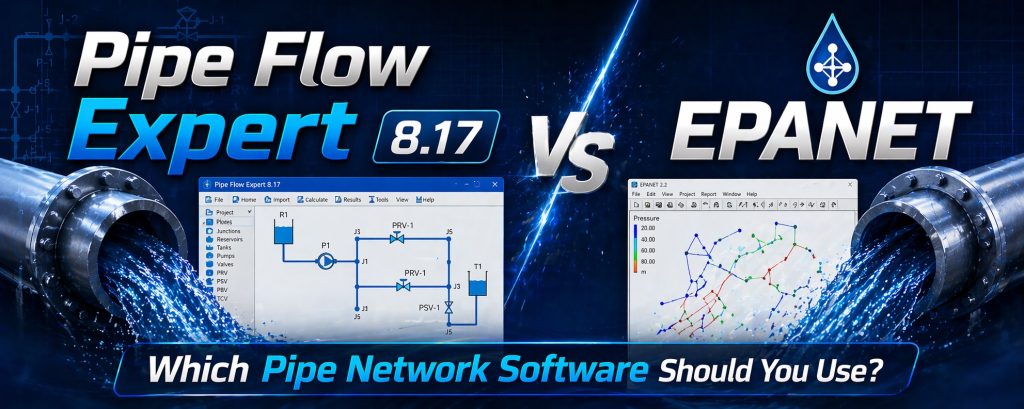
If you are evaluating pipe network analysis software, you will almost certainly encounter both Pipe Flow Expert and EPANET in your search. One is free, developed by a US government agency, and used by water utilities worldwide. The other is a commercial product used by engineers across oil and gas, pharmaceutical, power generation, food and beverage, and dozens of other industries. They are often listed side by side in software comparisons, but they are not competing for the same job.
This article gives you a direct, detailed comparison of both tools — what each does well, where each falls short, and the specific scenarios where one is clearly the better choice. If you are trying to decide between them for a real project, this should be the only comparison you need to read.
Quick Summary
| Feature | Pipe Flow Expert 8.17 | EPANET 2.2 |
|---|---|---|
| Cost | Commercial (paid license) | Free (public domain) |
| Developer | Pipe Flow Software Ltd (UK) | US EPA |
| Primary use case | Multi-industry pipe network analysis | Water distribution system modeling |
| Fluid support | 400+ fluids — liquids and gases | Water only |
| Gas flow calculations | Yes — full compressible gas support | No |
| Water quality modeling | No | Yes — chlorine, age, contaminants |
| Extended period simulation | Steady state only | Yes — time-varying demand and control |
| Network size limit | 1,000 pipes (full version) | Unlimited |
| Pump modeling | Full curve, multi-speed, efficiency | Head-flow curve |
| PDF / Excel reports | Yes — professional, customizable | Limited built-in reporting |
| Operating system | Windows only | Windows (third-party GUIs available) |
| Isometric 3D drawing | Yes | No |
| GIS integration | No | Via third-party tools |
| Open source | No | Yes (EPANET 2 toolkit) |
What Is EPANET
EPANET is a free, open-source pipe network modeling tool developed by the US Environmental Protection Agency (EPA) and first released in 1993. It was built specifically to help water utilities simulate hydraulic and water quality behavior in pressurized drinking water distribution systems. The EPANET 2.2 release is the current version and includes pressure-dependent demand analysis alongside the classic demand-driven simulation.
EPANET’s hydraulic solver uses the Gradient Method (a Newton-Raphson variant) and supports three head loss equations: Hazen-Williams, Darcy-Weisbach, and Chezy-Manning. Its water quality simulation can track chlorine residuals, water age, source tracing, and multi-species reactions (via the EPANET-MSX extension). Because it is public domain software, its computational engine has been embedded in dozens of commercial products, and the .inp file format has become a de facto standard for water network data exchange.
EPANET handles networks of essentially unlimited size — real-world models with 10,000+ pipes and nodes are routinely run on it. It supports extended period simulation (EPS), meaning it can model how a network behaves over time as demand varies, tanks fill and empty, and pump schedules change. This capability is central to water utility operations planning.
What Is Pipe Flow Expert
Pipe Flow Expert is a commercial pipe network analysis tool developed by Pipe Flow Software Ltd in the UK and used by engineers at over 3,000 companies across more than 100 countries. Unlike EPANET, it was not designed for any single industry. It handles any fluid — water, oil, gas, acid, refrigerant, steam condensate — and any industry where pipes carry fluid under pressure.
Pipe Flow Expert uses the Darcy-Weisbach equation for pressure drop with the Colebrook-White equation for friction factors, and implements a Newton-Raphson network solver. Version 8 extended the software with a full compressible isothermal gas flow capability covering AGA, Weymouth, Panhandle A and B, and IGT equations. It operates in steady state only — it does not model time-varying network behavior. Results are presented as a graphical system drawing with an interactive results sheet and can be exported as a professional PDF report.
Fluid Support — The Most Important Difference
This is where the two tools diverge most fundamentally. EPANET models water. Full stop. It assumes water properties throughout and does not allow you to change the fluid. Its head loss equations — particularly Hazen-Williams, which is the default in many models — are empirically derived for water and are not valid for other fluids or for temperatures significantly different from ambient.
Pipe Flow Expert supports over 400 fluids with properties defined across temperature ranges. You can model water, crude oil, diesel, glycol solutions, sulfuric acid, liquid ammonia, liquid CO2, food-grade oils, and dozens of refrigerants — plus a full range of gases with real gas property calculations. If you work with any fluid other than water, EPANET simply cannot do the job. Pipe Flow Expert can.
For gas networks specifically, Pipe Flow Expert implements the complete set of equations used in professional gas transmission engineering, with automatic density adjustment for pressure changes along the pipe. EPANET has no gas flow capability at all.
Water Quality Modeling — Where EPANET Has No Peer
In the opposite direction, EPANET has a capability that Pipe Flow Expert entirely lacks: water quality simulation. EPANET can track how a constituent moves through a water distribution network over time. It models chlorine decay (first-order and second-order), water age (which correlates with water quality deterioration), and source tracing (what fraction of water at any point came from a given source).
The EPANET-MSX (Multi-Species Extension) adds the ability to model interactions between multiple chemical species simultaneously — for example, the formation of trihalomethanes as a byproduct of chlorination. This capability is essential for water utility engineers conducting disinfection compliance studies, vulnerability assessments, and source water blending analysis.
Pipe Flow Expert has no water quality module and no plans to add one. If water quality simulation is a requirement of your project, EPANET (or a commercial product built on its engine, such as WaterGEMS or WaterCAD) is the right tool.
Extended Period Simulation vs. Steady State
EPANET runs extended period simulations (EPS) — it models network behavior across a time period (typically 24 hours or longer) as demand patterns vary hour by hour, tanks fill and empty, and pump schedules execute. This is the standard mode of operation for water distribution system analysis, where peak hour demand, fire flow events, and overnight low-demand conditions all need to be evaluated.
Pipe Flow Expert is a steady-state tool. It solves the network for a single operating condition at a time. To evaluate different operating scenarios you set up and solve each one separately. This is not a limitation for most industrial applications — a process plant piping system, a cooling water circuit, or a gas distribution network operates at defined steady-state conditions most of the time, and that is what you need to design for.
For water utility distribution system planning, where tank level management, demand variation, and pump scheduling are central concerns, EPANET’s EPS capability is essential and cannot be replicated in Pipe Flow Expert.
Pump Modeling
Both tools model pumps using head-flow curves, but Pipe Flow Expert goes significantly further. Its pump modeling includes:
- Full pump curve entry via multiple data points or by clicking on an imported pump manufacturer graph image
- Multi-speed pump modeling using affinity law predictions from a single reference curve
- Efficiency curve overlays and iso-efficiency lines
- NPSH (Net Positive Suction Head) curves for cavitation assessment
- Pump data sheets in PDF format with one click
- A searchable pump database with over 100 example pumps
- Support for multiple pumps in any series/parallel combination
EPANET supports pump head-flow curves with multiple data points and can model variable speed pumps via a speed factor. It does not provide efficiency curves, NPSH analysis, or pump data sheet generation. For water utility modeling, this level of pump detail is usually adequate. For industrial applications where pump selection and performance verification are part of the engineering scope, Pipe Flow Expert’s pump tools are considerably more complete.
Reporting and Documentation
EPANET provides tabular and graphical output within the application: pressure and flow results at all nodes and pipes, color-coded network maps, time series graphs for EPS results, and basic text reports. For more sophisticated reporting, users typically export data to spreadsheets or post-processing tools. The application itself does not generate formal engineering documents.
Pipe Flow Expert generates a professional multi-page PDF report with one click. The report includes a scaled system drawing, results tables for all pipes and nodes, pump performance data, fluid properties, energy calculations, and supports custom company logos and report branding. For engineering consultants who need to deliver calculation packages to clients, or for engineers maintaining project documentation, this reporting capability has real practical value. It is one of the features most frequently cited in user reviews of Pipe Flow Expert.
Interface and Ease of Use
EPANET’s interface is functional but dated — it reflects its origins in the 1990s and has not had a major UI overhaul. The built-in graphical network editor is adequate for building models, and the software works well once you understand its conventions. However, the learning curve for new users is steeper than it needs to be, and the interface limitations become more noticeable on complex projects. A number of third-party GUI tools (OpenFlows, QEPANET, and others) have been developed to address these shortcomings.
Pipe Flow Expert was built from the ground up with usability as a stated priority. The 2D and isometric 3D drawing interface, interactive results display, drag-and-drop network construction, and context-sensitive data entry are all more polished than EPANET. Most users can complete their first calculation within minutes of installing the software. This is not a minor point — engineers who are not full-time hydraulic modelers (plant engineers, project engineers, consultants) benefit significantly from a tool they can pick up and use productively without a learning curve.
Network Size and Scalability
EPANET has no practical network size limit. Models with tens of thousands of pipes and nodes are routinely run. This makes it the appropriate tool for large municipal water distribution systems where the entire network topology needs to be represented.
Pipe Flow Expert Full version handles up to 1,000 pipes. The Lite version handles up to 25 pipes. For most industrial and process engineering applications — a refinery unit, a building HVAC system, a fire suppression network, a chemical plant utility system — 1,000 pipes is more than sufficient. For very large water distribution networks that need to be modeled in full, this limit is a genuine constraint.
Cost
EPANET is free. Always has been. It is public domain software from a US government agency and will remain free indefinitely. This is a significant advantage for water utilities, academic institutions, and smaller consultancies working on public infrastructure projects where software budgets are limited.
Pipe Flow Expert requires a paid license. The license is annual and covers technical support and software updates for 12 months. Network licenses are available for organizations with multiple concurrent users. The cost is justified for engineering firms where the time saved on calculation, verification, and report preparation has a clear commercial value — but it is a real cost that needs to be weighed against the free alternative.
Who Should Use EPANET
- Water utility engineers modeling drinking water distribution systems for planning, operations, and compliance
- Researchers and academics studying water distribution hydraulics and water quality
- Municipal consultants designing or upgrading public water supply networks
- Engineers who need extended period simulation — demand variation, tank cycling, and pump scheduling over time
- Projects with budget constraints where a free tool meets the technical requirements
- Teams integrating with GIS — EPANET’s .inp format is supported by most GIS-based hydraulic modeling platforms
- Anyone who needs chlorine modeling, water age analysis, or contaminant propagation simulation
Who Should Use Pipe Flow Expert
- Process and chemical engineers working with any fluid other than water — oils, gases, acids, refrigerants, solvents
- Oil and gas engineers designing pipeline networks, gas gathering systems, or production facility piping
- Mechanical engineers in power generation, pharmaceutical, food and beverage, or mining sectors
- Engineering consultants who need to deliver formal, branded calculation reports to clients
- Engineers who need compressible gas network analysis — EPANET has zero gas capability
- Teams who need pump selection and NPSH analysis as part of the network calculation
- Engineers who prefer a polished, fast-to-learn interface over a free but dated tool
- Industrial facility engineers handling cooling water, fire protection, compressed air, or steam condensate systems
Can You Use Both
Yes — and for some organizations, it makes sense. A water utility engineering department might use EPANET for distribution system planning and Pipe Flow Expert for pump station internal piping design, fire protection system analysis, or any non-water system on the same site. The tools are complementary rather than directly competitive for teams that work across different types of projects.
Some engineers also use EPANET for the hydraulic backbone of a water network model and export results for verification or post-processing in other tools. EPANET’s open toolkit (API in C) enables integration with custom software, which is not an option with Pipe Flow Expert.
The Bottom Line
The choice between Pipe Flow Expert and EPANET is usually straightforward once you frame it correctly. The question is not which tool is better — it is which tool is right for your specific job.
If you are modeling a pressurized water distribution network and need extended period simulation, water quality analysis, or GIS integration, EPANET is the correct tool, and its being free makes the decision easy.
If you are working with any fluid other than water, need gas flow calculations, require professional PDF reports for client delivery, or want a tool that engineers without specialist training can use productively from day one, Pipe Flow Expert is the right choice. Its paid license reflects capabilities that EPANET simply does not have and was never designed to have.
The engineers who find this comparison most useful are typically those working in water-adjacent industries — facility engineers at water treatment plants, engineers designing building water services, or consultants who handle both municipal and industrial projects. For them, knowing exactly where each tool’s scope ends is what allows them to choose quickly and get on with the work.
Get a license — free consultation
Pricing depends on version and number of users. Message us on Telegram and we’ll reply with an exact quote — no commitment required.
|
✓
20+ years experience
Software engineers with a long track record
|
⚡
Delivered within 24h
Your license is sent within one business day
|
↩
Money-back guarantee
If the license doesn’t work, we refund in full
|
Usually reply within a few hours — free consultation, no upfront payment