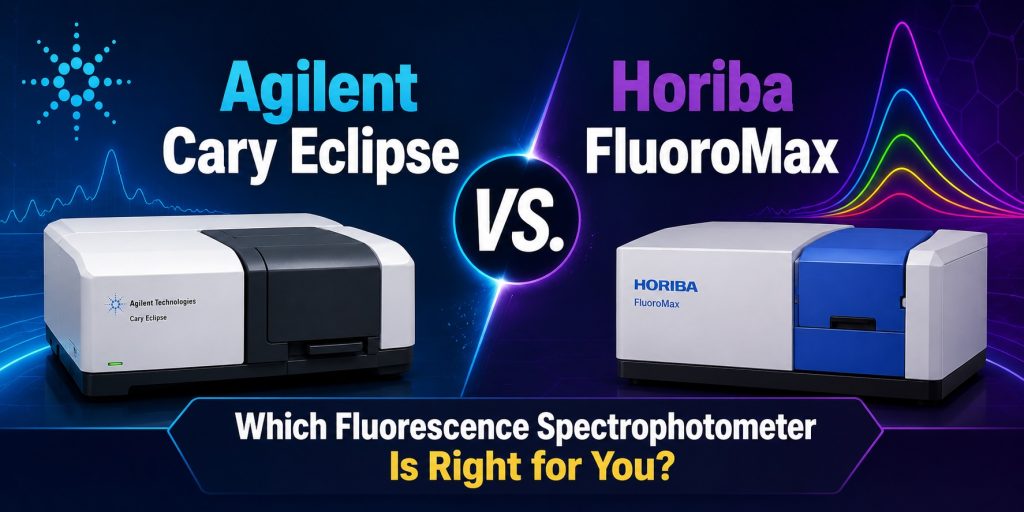
| Feature | Agilent Cary Eclipse | Horiba FluoroMax Plus |
|---|---|---|
| Manufacturer | Agilent Technologies | HORIBA Scientific |
| Light Source | Xenon flash lamp (80 Hz, pulsed) | Continuous 150W Xenon arc lamp |
| Lamp Warranty | 10 years | Standard (typically 1–2 years) |
| Excitation Range | 200–900 nm | 200–900 nm (UV-VIS) |
| Emission Range | 200–900 nm | 200–1700 nm (with NIR detector) |
| Scan Speed | 24,000 nm/min | Up to ~100 nm/s typical |
| Lifetime Measurement | Time-resolved phosphorescence mode | TCSPC down to 25 ps (FluoroMax Plus) |
| Control Software | Cary WinFLR | FluorEssence (Origin-based) |
| Room Light Immunity | Yes (unique feature) | No (requires darkened sample compartment) |
| Microplate Reader Option | Yes (up to 384 wells) | Limited accessory options |
| NIR Detection | No (standard configuration) | Yes (up to 1700 nm with InGaAs detector) |
| Photon Counting | No (analog PMT) | Yes (photon counting PMT) |
| Sample Protection | Pulsed illumination only when acquiring | Continuous illumination (shuttered) |
Background and Market Position
The Cary Eclipse has its roots in Varian’s instrumentation division, which Agilent Technologies acquired in 2010. The instrument has been on the market in various generations for well over two decades and is particularly dominant in pharmaceutical quality control, bioanalytical research, and high-throughput screening applications. Agilent’s broader ecosystem — including UV-Vis spectrophotometers and HPLC systems — makes the Cary Eclipse a natural fit for laboratories that already standardize on Agilent hardware and software workflows.
The Horiba FluoroMax line has an equally long heritage. HORIBA Scientific, the analytical instruments division of the Japanese conglomerate HORIBA Ltd., introduced the FluoroMax in the 1990s, and it was one of the first benchtop spectrofluorometers to bring modular-instrument sensitivity to a tabletop form factor. The current FluoroMax Plus represents the culmination of more than 30 years of continuous development, with photon-counting detection and NIR capability that push well beyond what earlier benchtop instruments could achieve.
Both instruments enjoy installation in thousands of university and industrial laboratories globally, which means peer-reviewed literature using both platforms is abundant — an important practical consideration when your measurement results need to be contextualized against published reference data.
Light Source Technology: Flash vs. Continuous Arc
The single most architecturally significant difference between these two instruments is how they generate excitation light.
The Agilent Cary Eclipse uses a pulsed xenon flash lamp operating at 80 flashes per second. This design philosophy drives many of the instrument’s most distinctive characteristics. Because the lamp fires in brief, intense pulses rather than shining continuously, several advantages follow: the sample is only illuminated at the moment of data acquisition, dramatically reducing photodegradation of sensitive analytes; the high peak intensity of each pulse enables detection of phosphorescent and time-resolved species through time-gating; the instrument achieves room light immunity, meaning measurements can be taken with the sample compartment open and under normal laboratory lighting conditions; and the lamp itself lasts far longer, which is why Agilent backs it with a 10-year warranty — a significant total cost of ownership advantage.
The Horiba FluoroMax Plus uses a continuous 150W xenon arc lamp. Continuous illumination is the traditional approach for steady-state fluorescence measurements and enables a fundamentally different detection architecture: photon counting. Rather than measuring an integrated signal from a large burst of photons (as in the pulsed approach), the FluoroMax Plus counts individual photons as they arrive at the detector. This approach delivers superior absolute sensitivity for very weak signals — the instrument can reliably quantify emissions at extremely low photon fluxes that would be statistically difficult to distinguish from noise in an analog detection system. The trade-off is that continuous illumination means the sample is always being exposed to excitation light during a measurement, which can cause photodegradation of sensitive biological samples over extended runs.
Neither approach is universally superior. For routine analytical work, quality control, and high-throughput screening, the Cary Eclipse’s pulsed architecture is practical and highly capable. For demanding photophysical research where single-photon-level sensitivity or sub-100 ps lifetime resolution is required, the FluoroMax Plus has the edge.
💬 Need a license or have questions? → Message us on Telegram — free consultation, usually reply within a few hours.
Measurement Modes
Both instruments support the core fluorescence measurement types, but their mode coverage diverges in meaningful ways.
The Cary Eclipse supports four primary collection modes: fluorescence (standard excitation/emission scanning), phosphorescence (exploiting the pulsed lamp to gate out prompt fluorescence), chemiluminescence and bioluminescence (measuring self-emitting samples without an excitation source), and time-resolved phosphorescence. This coverage is well matched to pharmaceutical applications, environmental analysis, food safety testing, and biochemical research involving protein folding, DNA binding, and enzyme kinetics.
The FluoroMax Plus adds Time-Correlated Single Photon Counting (TCSPC) as a core capability, enabling fluorescence lifetime measurements with resolution down to 25 picoseconds. This is essential for photophysics research, FRET (Förster Resonance Energy Transfer) studies, excited-state dynamics, and work on advanced luminescent materials where ns-to-ps decay components need to be resolved. The FluoroMax Plus also supports PLQY (photoluminescence quantum yield) measurements — critical for characterizing quantum dots, OLEDs, and other electroluminescent materials.
If your laboratory’s measurement needs are centered on classical steady-state fluorescence, the Cary Eclipse’s mode coverage is more than sufficient. If you work in photophysics, materials science, or biophysics requiring nanosecond-to-picosecond lifetime resolution, the FluoroMax Plus is the stronger platform.
Spectral Range and Near-Infrared Capability
In standard configuration, both instruments cover the 200–900 nm range for both excitation and emission — adequate for the overwhelming majority of fluorescent dyes, probes, and naturally fluorescent compounds encountered in analytical and biochemical work.
The FluoroMax Plus has a significant advantage for laboratories working beyond the visible spectrum. With an optional liquid-nitrogen-cooled InGaAs NIR detector, the instrument extends emission detection out to 1700 nm. This opens up applications in NIR-emitting quantum dot characterization, rare earth luminescence, carbon nanotube photophysics, and NIR-based biomedical imaging probe development. The Cary Eclipse in its standard configuration does not extend into this NIR region, making the FluoroMax Plus the better choice for researchers in semiconductor materials, nanomaterials, and NIR biomedical optics.
Scan Speed and Kinetics
For high-throughput laboratories and fast kinetics applications, the Cary Eclipse holds a clear advantage. Its pulsed lamp architecture allows the instrument to capture a data point every 12.5 milliseconds, delivering scan speeds of up to 24,000 nm/min without peak shifts. At its fastest setting in steady-state mode, the instrument acquires up to 80 data points per second. For stopped-flow kinetics studies, the instrument supports measurements of fast reactions in the 1–2 second range using rapid-mix or stopped-flow accessories.
The FluoroMax Plus, with its continuous-source photon-counting architecture, is inherently better suited to accumulating high-quality, low-noise spectra through longer integration times rather than extremely rapid scanning. For most research applications this is not a limitation — few experiments genuinely require 24,000 nm/min scan speeds. But for industrial QC environments processing large sample batches, or for kinetics work requiring sub-second time resolution across a wide spectral window, the Cary Eclipse’s throughput advantage is material.
Software Ecosystem: WinFLR vs. FluorEssence
Software is where many laboratories feel the impact of instrument choice most acutely in day-to-day operation. Both platforms have mature, Windows-based software packages — but they are philosophically different.
Agilent Cary WinFLR is the dedicated control and analysis software for the Cary Eclipse family. It is designed to present a clean, application-focused workflow that works for both novice operators and experienced researchers. The software allows users to switch between measurement modes without any hardware changes — a genuine convenience in shared-instrument environments. WinFLR integrates data acquisition, spectral analysis, quantitation, kinetics, and reporting within a single environment. For a comprehensive breakdown of WinFLR’s features, modules, and licensing options, see our detailed guide: Agilent Cary Eclipse WinFLR Software — Complete Guide, Features & 2026 Update.
HORIBA FluorEssence takes a notably different approach: it is built on top of Origin® software by OriginLab, a widely used scientific data analysis and graphing platform. This architecture means that FluorEssence users inherit Origin’s powerful data processing and visualization capabilities — including curve fitting, statistical analysis, and publication-quality graphing — directly within the acquisition environment. For researchers who already use Origin for data analysis, this tight integration is a significant productivity advantage. For operators accustomed to simpler dedicated instrument software, the Origin-based interface may present a steeper initial learning curve.
An important practical consideration: FluorEssence’s dependence on Origin means the software’s full functionality requires a valid Origin license in addition to the FluorEssence license. Laboratories must account for this in their software procurement and support planning. WinFLR operates as a standalone package without external software dependencies.
Sample Handling and Accessories
Both platforms support standard 1 cm path-length fluorescence cuvettes and offer broad accessory ecosystems, but their accessory strengths differ.
The Cary Eclipse’s room light immunity — a consequence of its pulsed lamp design — is a unique and practically important advantage. The instrument can operate with its sample compartment panels removed, enabling large or awkward accessories to be installed without modifying the instrument housing, and allowing real-time visual inspection of samples during measurement. This is particularly useful in microbiological applications, stopped-flow kinetics, and work with non-standard sample geometries.
The microplate reader accessory for the Cary Eclipse supports full wavelength scanning of up to 384-well plates, making it one of the few benchtop spectrofluorometers capable of genuine high-throughput screening with spectral resolution across the full UV-visible range. This is a compelling differentiator for drug discovery and biochemical assay development laboratories.
The FluoroMax Plus accessory ecosystem is oriented differently — toward photophysical research applications. The two-position grating turret, NIR InGaAs detector, and enhanced TCSPC lifetime detectors reflect a research-focused accessory philosophy. HORIBA also offers a broad range of excitation light sources for TCSPC work, including pulsed diode lasers and LED sources, enabling precise control of excitation wavelength and pulse duration for lifetime experiments.
Sensitivity and Signal-to-Noise
Sensitivity comparisons between different detection architectures require care. The FluoroMax Plus uses photon counting, which HORIBA characterizes using the First Standard Deviation (FSD) water Raman S/N method — a rigorous statistical measure applicable to photon-counting systems. Photon counting inherently provides superior detection of very weak signals because it avoids the additive noise floor of analog detection electronics.
The Cary Eclipse uses an analog PMT detector optimized for its pulsed-lamp architecture. For most analytical applications in the nanomolar to micromolar concentration range, the Cary Eclipse provides fully adequate sensitivity. For detection of extremely dilute samples at picomolar concentrations or below, or for measuring weak luminescent materials with low quantum yields, the FluoroMax Plus’s photon-counting sensitivity may provide a meaningful advantage.
A practical advantage of the Cary Eclipse’s pulsed design is the ability to measure picomolar fluorescein concentrations in volumes below 0.5 mL — useful for precious biological samples — combined with the sample protection afforded by the instrument only illuminating the sample during actual data acquisition.
Which Instrument for Which Application?
After a detailed evaluation of both platforms, the appropriate choice depends heavily on your primary use case:
Choose the Agilent Cary Eclipse if your work involves: pharmaceutical quality control and method validation; bioanalytical research requiring phosphorescence and bioluminescence modes; high-throughput screening with the microplate reader; stopped-flow and rapid kinetics; routine fluorescence in a shared-instrument core facility; or laboratories already standardized on Agilent hardware. The 10-year lamp warranty also makes the Cary Eclipse a strong choice on total cost of ownership grounds for any laboratory planning a 5–10 year instrument life cycle. For complete information on the instrument’s control and analysis software, visit our full WinFLR software guide.
Choose the Horiba FluoroMax Plus if your work involves: fluorescence lifetime measurements at nanosecond-to-picosecond resolution; TCSPC-based FRET or excited-state dynamics studies; NIR luminescence characterization of quantum dots, rare earth materials, or carbon nanostructures; PLQY determination for photovoltaic or OLED materials; or research environments where deep integration with Origin-based data analysis workflows is valued.
💬 Need a license or have questions? → Message us on Telegram — free consultation, usually reply within a few hours.
Cost and Total Cost of Ownership
Both instruments are positioned in the mid-to-high tier of the benchtop spectrofluorometer market. List pricing for new units typically falls in the $40,000–$80,000 USD range depending on configuration and accessories, with significant variation by region and distributor. Detailed pricing should be obtained directly from Agilent or HORIBA regional offices, as academic, government, and volume pricing are commonly available.
On a total cost of ownership basis, the Cary Eclipse’s 10-year lamp warranty is a notable advantage. Xenon lamp replacement on fluorescence instruments is a recurring maintenance cost that typically runs into thousands of dollars per replacement, plus technician time and downtime. Agilent’s warranty commitment effectively removes this variable cost for a decade of operation, which can materially shift the TCO comparison in favor of the Cary Eclipse for laboratories evaluating long-term ownership economics.
The FluoroMax Plus’s requirement for a separate Origin software license for full FluorEssence functionality is a cost factor that is sometimes overlooked in initial procurement comparisons. Laboratories should verify the licensing requirements and associated annual costs with HORIBA before finalizing a budget.
Support, Documentation, and Global Presence
Both Agilent Technologies and HORIBA Scientific maintain global service and support networks with field application scientists, calibration services, and spare parts availability. For most major markets in North America, Europe, and Asia-Pacific, service response times and spare parts availability are comparable between the two vendors.
Agilent’s integration into a broader analytical instrumentation portfolio (UV-Vis, LC-MS, ICP-MS, and related techniques) means that laboratories using multiple Agilent platforms may find consolidated service agreements and single-vendor relationships more straightforward to manage. HORIBA Scientific, as a dedicated scientific instruments division, brings deep domain expertise in fluorescence and light-scattering techniques that can be advantageous for specialized research applications.
Frequently Asked Questions
Can the Cary Eclipse measure fluorescence lifetime?
The Cary Eclipse supports time-resolved phosphorescence, which allows measurement of longer-lived luminescent species through time-gating of the pulsed lamp signal. However, it does not support TCSPC-based fluorescence lifetime measurements at nanosecond-to-picosecond resolution. For lifetime work in that time regime, the FluoroMax Plus with TCSPC capability is the appropriate instrument.
Can the FluoroMax Plus replace the Cary Eclipse for pharmaceutical QC?
The FluoroMax Plus is a capable analytical instrument, but the Cary Eclipse is more commonly validated and documented in pharmaceutical QC method libraries, and its workflow within WinFLR is more directly oriented toward regulatory documentation and batch reporting. For USP/ICH method compliance in a GMP environment, the Cary Eclipse ecosystem has a stronger established track record.
What software does each instrument require?
The Cary Eclipse requires Agilent Cary WinFLR, a standalone Windows application distributed with the instrument. The FluoroMax Plus uses FluorEssence, which runs on top of OriginLab Origin software. Both require valid license keys for operation. For detailed information on WinFLR installation, features, and licensing, see our guide at docrack.me/en/cary-eclipse-winflr-software/.
Which instrument is better for measuring quantum dots?
For quantum dots with emission in the visible range (400–700 nm), both instruments are suitable. For NIR-emitting quantum dots with emission beyond 900 nm — common in biomedical imaging applications — the FluoroMax Plus with its optional InGaAs detector extending to 1700 nm is the preferred choice.
Is room light immunity really useful in practice?
Yes — particularly in shared instrument facilities and for work with large, non-standard accessories. Being able to load samples, adjust accessory configurations, and troubleshoot optically without fully enclosing the sample compartment significantly reduces setup time and frustration. It is also relevant for any stopped-flow or rapid-injection experiments where you need physical access to the sample compartment during a measurement run.
Which instrument has better long-term support?
Both Agilent and HORIBA are major global companies with long-term commitments to their spectroscopy product lines. The Cary Eclipse’s 10-year lamp warranty provides a concrete, manufacturer-backed service commitment. Both instruments have large installed bases, which typically supports continued spare parts availability and software updates over multi-decade instrument lifetimes.
Conclusion
The Agilent Cary Eclipse and the Horiba FluoroMax Plus are both excellent instruments with decades of proven performance. The Cary Eclipse excels in high-throughput environments, pharmaceutical and bioanalytical applications, fast kinetics, and multi-mode luminescence measurements within a workflow optimized by WinFLR software. Its pulsed lamp design, room light immunity, 10-year lamp warranty, and microplate reader capability make it a practical workhorse for a broad range of analytical laboratories. The FluoroMax Plus excels in photophysical research demanding TCSPC lifetime resolution, NIR detection, and the deep data analysis integration afforded by its Origin-based FluorEssence software.
For most analytical, pharmaceutical, and bioanalytical laboratories, the Cary Eclipse is the more practical choice. For research groups in photophysics, materials science, and nanophotonics where ps-lifetime resolution or NIR detection is a core requirement, the FluoroMax Plus is the better fit. Understanding both instruments’ software environments is as important as understanding their hardware — for a deep dive into the Cary Eclipse’s software capabilities, including installation guidance and licensing information, see our comprehensive article on Agilent Cary Eclipse WinFLR Software.
Get a license — free consultation
Pricing depends on version and number of users. Message us on Telegram and we’ll reply with an exact quote — no commitment required.
|
✓
20+ years experience
Software engineers with a long track record
|
⚡
Delivered within 24h
Your license is sent within one business day
|
↩
Money-back guarantee
If the license doesn’t work, we refund in full
|
Usually reply within a few hours — free consultation, no upfront payment