
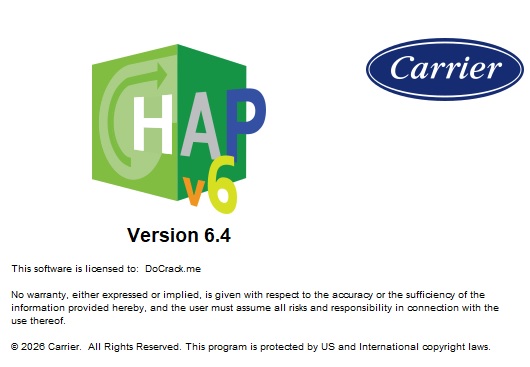
What Is Carrier HAP?
HAP is a dual-function program: it combines a full-featured peak load calculator and system sizing tool with a versatile hour-by-hour energy simulation engine, all in one package. It is part of Carrier’s eDesign Suite — a collection of specialized HVAC design programs that also includes System Design Load (SDL), Building System Optimizer (BSO), Refrigerant Piping Design (RPD) and Engineering Economic Analysis.
Primary users are consulting engineers, design-build contractors, HVAC contractors and building systems engineers working on commercial projects of any scale. HAP is also the go-to tool for LEED energy analysis and projects that must demonstrate compliance with ASHRAE energy standards.
Core Features of HAP 6.4
1. ASHRAE Heat Balance Load Calculation
HAP calculates thermal loads using the ASHRAE Heat Balance Method — the most rigorous load calculation procedure in international standards. It accounts simultaneously for solar radiation, envelope conduction, internal gains (people, lighting, equipment) and infiltration, producing results that can be directly used for equipment selection and system sizing.
2. Graphical 3D Building Modeling
The graphical input interface lets users assemble a 3D building model quickly, reducing both time spent on data entry and the risk of input errors. For complex projects — multi-story office towers, hotels, hospitals or mixed-use developments — this visual approach makes it practical to model every zone accurately.
3. Full 8,760-Hour Energy Simulation
HAP’s energy engine simulates HVAC system operation for every hour of the year. This comprehensive analysis yields annual energy consumption, monthly component breakdowns, electrical demand peaks and operating cost estimates. The simulation engine is built on EnergyPlus, the US Department of Energy’s reference-grade building energy simulation program.
4. System-Based Design Sizing
Rather than applying generic sizing rules, HAP uses System-Based Design — sizing procedures that are tailored to the specific system type being designed. A VAV system, a chilled-water fan-coil system and a packaged rooftop each follow appropriate sizing logic, ensuring components are neither over- nor under-sized.
5. Wide HVAC System Coverage
HAP supports a broad range of commercial system types: all-air VAV and CAV systems, air-water systems, chilled-water plants with chillers and cooling towers, VRF systems, heat pumps, DOAS units and more. This coverage makes it suitable for virtually any commercial building typology.
6. Comprehensive Reports
The software produces tabular and graphical reports covering peak design loads, annual energy summaries, monthly and hourly energy breakdowns, operating cost comparisons and system sizing summaries. These reports are formatted for direct submission to clients, authorities or LEED review bodies.
7. BIM Integration via gbXML Import
HAP can import gbXML files exported from BIM platforms such as Autodesk Revit or AutoCAD MEP. This workflow eliminates the need to re-enter building geometry manually, significantly cutting modeling time on projects where a BIM model already exists.
💬 Need a license or have questions? → Message us on Telegram — free consultation, usually reply within a few hours.
What’s New in HAP 6.4 — 2026 Release
1. ASHRAE 62.1-2022 and 90.1-2022 Compliance
Version 6.4 adds support for the latest editions of two key ASHRAE standards. ASHRAE 62.1-2022 covers ventilation rates and indoor air quality requirements for non-residential buildings. ASHRAE 90.1-2022 is the energy efficiency standard for commercial buildings that underpins most green-building rating systems and many local energy codes worldwide. Engineers working on projects that reference either standard can now use HAP 6.4 with confidence that the software reflects the current requirements.
2. Spreadsheet Export for Design Load Results
A frequently requested feature — exporting peak load calculation results to a spreadsheet format — is now available in version 6.4. This makes it straightforward to post-process data, build custom summary reports, or share load results with equipment suppliers and other members of the design team without transcription errors.
3. Air-Source Heat Pump DOAS Modeling
HAP 6.4 adds the ability to model Dedicated Outdoor Air System (DOAS) units driven by air-source heat pumps. DOAS configurations — which handle outdoor air conditioning independently from the primary space-conditioning system — are increasingly specified in high-performance building designs. Pairing them with air-source heat pumps improves energy recovery and meets tighter efficiency targets.
4. Expanded Free Cooling Options for Chiller Plants
Version 6.4 offers more configuration options for modeling waterside economizer (free cooling) in chilled-water systems. This is particularly valuable in climates where cooler ambient conditions during winter and shoulder seasons allow the chiller plant to operate at significantly reduced energy consumption.
5. Building Modeling Improvements
Several enhancements to the building input workflow reduce the time required to configure complex models and help prevent common modeling mistakes. For engineers working through multiple projects simultaneously, these productivity gains add up quickly.
6. Bug Fixes from v6.3 and v6.3.1
All known issues from the previous release cycle have been resolved, improving calculation accuracy and overall stability. Upgrading to 6.4 is recommended for all active v6.3 licensees.
System Requirements
- Operating system: Windows 11 64-bit
- Hard disk space: 1 GB minimum
- RAM: 8 GB minimum (16 GB recommended for large projects)
- License: Customer number and license key delivered by email
HAP 6.4 uses the same license key as HAP 6.3 — existing licensees can upgrade without requesting a new key. Version 6.4 installs alongside v6.3; both can run on the same machine.
HAP vs. Competing HVAC Software
Engineers evaluating HAP against tools such as Trane TRACE, eQUEST or IDA ICE should consider a few differentiators. HAP uniquely combines load calculation, system sizing and full 8,760-hour energy simulation in one environment — many competing tools handle only one or two of these tasks. Its simulation engine is EnergyPlus, giving it the credibility of a DOE-validated calculation core. It is accepted by the US Department of Energy for commercial building tax deduction calculations (Section 179D) and is fully supported for LEED Energy and Atmosphere credit analysis. Technical support comes from Carrier’s in-house team of HVAC engineers, not a third-party help desk.
Typical Use Cases
Large Commercial & Mixed-Use Buildings
Office towers, shopping centers and multi-use complexes require accurate load data and verified energy models before equipment procurement. HAP’s 3D modeling interface and zone-level load reports make it practical to handle hundreds of spaces in a single project.
Hospitals and Healthcare Facilities
Healthcare projects demand precise control of temperature, humidity and air quality. HAP’s ASHRAE 62.1-2022 ventilation calculations and ability to model pressure-relationship requirements make it well suited for operating rooms, isolation rooms, laboratories and other critical spaces.
Hotels and Hospitality Projects
Hotels combine high-occupancy public spaces with individual guestroom zones and back-of-house areas, each with distinct load profiles. HAP handles this diversity within a single building model and produces the energy cost comparisons that investors and operators need to evaluate system options.
Industrial and Process Facilities
Pharmaceutical manufacturing, electronics clean rooms, food processing and similar facilities have HVAC requirements driven by process loads rather than occupancy. HAP can model high internal heat gain environments and specialized system configurations appropriate to these applications.
Green Building and Energy Code Compliance
For projects pursuing LEED certification or demonstrating compliance with ASHRAE 90.1 Appendix G, HAP automates the baseline model rotations (90°, 180°, 270°) required by the standard and generates the documentation reviewers expect. Its status as a DOE-accepted simulation tool means results carry weight with certifying bodies.
Data Centers
With the growing importance of data center infrastructure globally, HAP’s ability to handle very high miscellaneous sensible heat gains makes it appropriate for modeling server hall cooling configurations alongside conventional HVAC systems in the same building.
Licensing and How to Get It
HAP is licensed through Carrier’s authorized distributor network. A single license covers up to 10 users, making it cost-effective for mid-size engineering teams. After purchase, Carrier delivers a customer number and license key by email along with a download link. The installation file is EDG-HAP640.EXE. On first launch the license key screen appears; entering the customer number and pasting the key activates the software.
Carrier also offers a free 60-day trial of the full eDesign Suite, including HAP, so engineers can evaluate the software against real project conditions before committing to a license purchase.
💬 Need a license or have questions? → Message us on Telegram — free consultation, usually reply within a few hours.
Frequently Asked Questions
What does Carrier HAP 6.4 do?
HAP 6.4 calculates peak heating and cooling loads for commercial buildings using the ASHRAE Heat Balance Method, sizes HVAC system components using System-Based Design procedures, and performs detailed hour-by-hour energy modeling for all 8,760 hours of the year. It is used for equipment selection, system design, energy cost comparison and LEED documentation.
What is new in HAP 6.4 compared to 6.3?
The April 2026 release adds support for ASHRAE 62.1-2022 and 90.1-2022, a new spreadsheet export for peak load results, air-source heat pump DOAS unit modeling, expanded waterside free cooling options for chiller plants, building modeling workflow improvements, and resolution of all known bugs from v6.3 and v6.3.1.
Do I need a new license key to upgrade from 6.3 to 6.4?
No. HAP 6.4 uses the same license key as HAP 6.3. Existing licensees can install and activate v6.4 without requesting a new key. Both versions can be installed simultaneously on the same computer.
What are the system requirements for HAP 6.4?
Windows 11 64-bit, at least 1 GB of free disk space and 8 GB of RAM. For large multi-zone projects, 16 GB of RAM is recommended. The software requires a valid license key delivered at time of purchase.
How many users can share one HAP license?
A single HAP license permits up to 10 users, which suits most small-to-medium engineering practices without requiring per-seat purchasing.
Can HAP import Revit or CAD building models?
Yes. HAP supports gbXML file import. Any BIM or CAD tool that can export gbXML — including Autodesk Revit and AutoCAD MEP — can pass building geometry and space data directly into HAP, eliminating redundant data entry.
Is HAP suitable for LEED energy analysis?
Yes. HAP fully supports the LEED v4.0 workflow and ASHRAE 90.1 Appendix G analysis, including automatic generation of the 90°, 180° and 270° baseline model rotations. It is recognized by the US Department of Energy as qualified software for commercial building energy tax deduction calculations.
How does HAP compare to Trane TRACE?
Both are established commercial HVAC simulation tools with similar core capabilities. HAP’s simulation engine is EnergyPlus, which is widely accepted by rating bodies globally. HAP integrates load calculation, system sizing and energy simulation in one workflow, whereas some competing tools require separate programs for each task. Choice often comes down to regional availability, distributor support and team familiarity.
Is there a free trial available?
Yes. Carrier provides a free 60-day trial of the complete eDesign Suite, which includes HAP, SDL, BSO and RPD. The trial version has full functionality, giving engineers a meaningful evaluation period before purchasing a license.
What support is included with a HAP license?
Licensed users receive access to software updates, the built-in Help documentation, video training through Carrier University, and direct email support from Carrier’s HVAC engineering team at software.systems@carrier.com.
Carrier HAP 6.4 remains the benchmark tool for commercial HVAC load calculation and energy simulation, combining rigorous ASHRAE-compliant calculation methods with the practical efficiency engineers need on real projects. The 2026 release strengthens its compliance credentials with updated ASHRAE standards support and adds output and modeling capabilities that address long-standing user requests. For engineering teams looking to download and license HAP 6.4 or any other tool in the Carrier eDesign Suite, contact us via Telegram at t.me/DoCrackMe for pricing and guidance.
Get a license — free consultation
Pricing depends on version and number of users. Message us on Telegram and we’ll reply with an exact quote — no commitment required.
|
✓
20+ years experience
Software engineers with a long track record
|
⚡
Delivered within 24h
Your license is sent within one business day
|
↩
Money-back guarantee
If the license doesn’t work, we refund in full
|
Usually reply within a few hours — free consultation, no upfront payment


