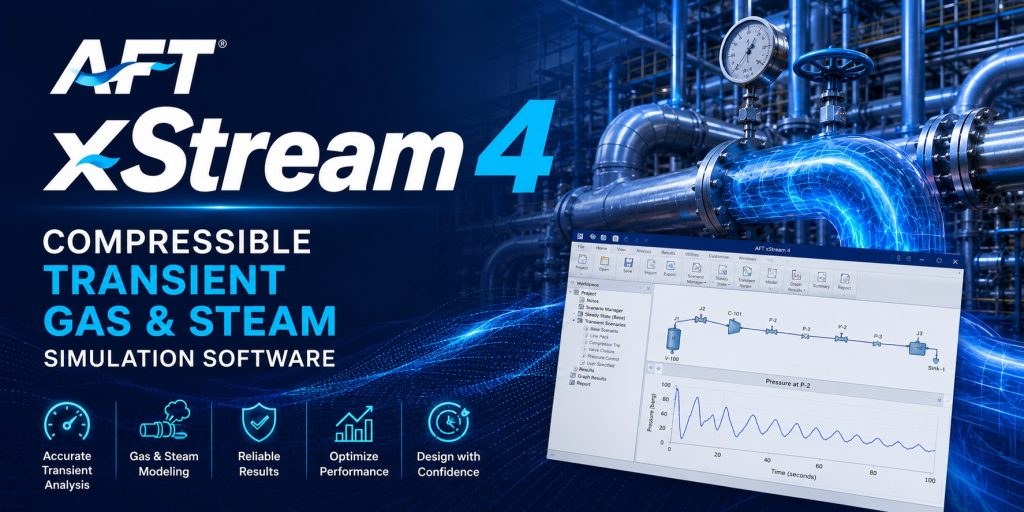
What Is AFT xStream?
AFT xStream is a compressible transient solver that tracks pressure waves, shocks, choking, and heat transfer in gas and steam networks over time. Unlike AFT Arrow, which addresses steady-state conditions, xStream is purpose-built for dynamic events — from the moment a valve begins to close to the point when pressure waves reflect back through an entire header system.
The software is trusted by engineering firms, plant operators, and research organizations worldwide, including companies like Jacobs, Siemens, and NASA. Applications span oil and gas, power generation, petrochemical, aerospace, pharmaceutical, and mining industries.
Core Capabilities
Compressible Transient Solver
xStream’s MOC-based engine models pressure waves and shocks in gas and steam networks during startups, trips, and emergency actions. It tracks pressure, temperature, density, velocity, and Mach number over time across the entire network. Flow from subsonic through choked conditions is handled, along with wave reflections at junctions, area changes, and boundary conditions. Pipe and duct heat transfer with temperature-dependent properties is also included.
Equipment and Valve Transients
Real equipment behavior during operational events is accurately captured. This includes compressor transients with speed profiles and staging (start/stop, ramping), time-dependent valve actions (Cv/Kv/K vs. time), regulators and relief devices, and full simulation of trips, restarts, damper moves, and ESD closures with event sequencing. Operating limits such as approach to choke, minimum flow, and surge margins can be checked throughout.
Blowdown, Venting, and ESD Analysis
xStream evaluates depressurization and emergency sequences to protect assets and personnel. Engineers can model unit and header blowdowns, isolation steps, and relief/vent interactions; predict time histories for pressures, temperatures, and mass flow to stacks or headers; compare relief setpoints, vent paths, and equipment configurations across scenarios; and verify allowable limits at tie-ins, branches, and downstream consumers.
Pulsation Frequency Analysis (PFA Module)
The optional PFA module quantifies pulsations and helps avoid acoustic resonance in gas and steam networks. It builds an acoustic network model to compute natural frequencies and mode shapes, evaluates pulsation amplitudes versus acceptance limits across operating points, and identifies resonance risks at headers and branches. Engineers can size and place pulsation control devices — bottles, accumulators, chambers, and orifices — and use spectral plots and envelopes to document compliance and compare designs.
Boundary Conditions and Controls
xStream supports pressure, mass flow, and temperature sources with schedules and ramps; time-varying restrictions such as dampers and nozzles; and user-defined events for trips, interlocks, and control sequences. Design alerts enforce allowable limits on pressure, temperature, and Mach number throughout the simulation.
Fluids and Property Libraries
Real-gas and ideal-gas options with temperature- and pressure-dependent properties are available. Steam and common industrial gases are included out of the box, with the ability to add custom fluids and mixtures. Gas composition can be defined by mass or mole fraction for accurate property calculations throughout the transient.
Workflow, Visualization, and Data Exchange
xStream includes a Scenario Manager to maintain design alternatives in a single file with inheritance and side-by-side comparisons. Results are communicated through time-history graphs, enveloping plots, animations, and color-mapped network diagrams that highlight bottlenecks, shocks, and choking locations. Excel import/export supports model data preparation and results handoff, while layout imports from common piping and duct formats accelerate model creation.
💬 Need a license or have questions? → Message us on Telegram — free consultation, usually reply within a few hours.
What’s New in AFT xStream 2026
The 2026 release of AFT xStream introduces meaningful improvements across solver performance, visualization, and modeling depth:
- Optimized MOC transient solver performance for large plant-scale networks, reducing run times on complex models
- Redesigned results visualization with enhanced color-mapped display of shocks, choking locations, and pressure wave propagation directly on the network diagram
- Expanded real-gas model support with more accurate temperature- and pressure-dependent property handling for a wider range of industrial gases
- Improved Scenario Manager with enhanced inheritance controls and simultaneous multi-scenario comparison views
- Upgraded PFA module with higher-fidelity resonance frequency identification for complex multi-branch networks
- Faster layout imports from common piping and duct drawing formats to accelerate model setup
- Advanced reporting templates with customizable formats for design reviews and project deliverables
- Enhanced support for flexible power generation (Flexgen) systems, enabling detailed gas transient analysis during fast-start turbine sequences
Industry Applications
Oil, Gas, and Petrochemical
xStream is widely used in upstream and midstream facilities for ESD analysis on compression trains, safe blowdown of high-pressure gas headers, and gas hammer evaluation on long transmission lines. Petrochemical plants use it to verify that depressurization procedures meet allowable temperature and pressure limits across all header tie-ins.
Power Generation
Steam-cycle and combined-cycle power plants rely on xStream to simulate turbine startups and shutdowns, evaluate steam valve behavior during emergency trips, and verify the integrity of high-pressure steam lines under transient loading. The Castlelost Flexgen case study, for example, demonstrates xStream’s use in gas transient analysis for fast-start power generation assets.
Aerospace and Defense
NASA and aerospace contractors use xStream for high-pressure gas system analysis, including propellant pressurization lines, test stand purge sequences, and pneumatic actuation systems where sonic choking and pressure wave dynamics are critical to safe operation.
Pharmaceutical and Food & Beverage
Facilities that rely on steam sterilization, CIP (clean-in-place) systems, and pressurized gas distribution use xStream to verify steam header behavior during valve actuation, assess the impact of rapid isolation events, and ensure process safety across distribution networks.
Mining and Minerals Processing
Mining operations with high-pressure compressed air or gas systems for pneumatic conveying, blast hole drilling, or mineral processing benefit from xStream’s ability to analyze surge events, compressor trip sequences, and relief valve sizing under dynamic conditions.
Engineering Consulting
EPC and consulting firms use xStream to deliver international-standard gas and steam transient analyses on client projects, producing defensible time-history results and reports for HAZOP reviews, pressure relief studies, and system qualification packages.
How xStream Compares to Other AFT Products
Datacor’s pipe flow modeling suite covers multiple simulation domains. AFT Fathom handles steady-state hydraulics in liquid and low-velocity gas systems. AFT Arrow covers steady-state compressible gas and steam networks. AFT Impulse analyzes liquid waterhammer (pressure surges in liquid piping). AFT xStream fills the gap for compressible transient events in gas and steam systems — the only tool in the suite that tracks pressure wave propagation, shock formation, and choking over time in a gaseous medium.
Licensing and Download
AFT xStream is available as a commercial license from Datacor. License options include standard single-user and network (floating) configurations. For procurement and download inquiries, contact our team via Telegram:
💬 Need a license or have questions? → Message us on Telegram — free consultation, usually reply within a few hours.
Frequently Asked Questions
What is AFT xStream used for?
AFT xStream is used to simulate compressible transient events in gas and steam piping systems — including emergency shutdowns, compressor trips, valve closures, blowdowns, and startup sequences. It predicts how pressure, temperature, Mach number, and flow rate change over time throughout a network, helping engineers verify safety limits and operational procedures before running them in a live plant.
How is xStream different from AFT Arrow?
AFT Arrow is a steady-state tool for sizing and balancing gas and steam networks under fixed operating conditions. AFT xStream is a time-accurate transient solver that tracks pressure waves, shocks, and dynamic equipment behavior during operational events. If your analysis involves anything that changes over time — a valve opening, a compressor trip, an ESD sequence — xStream is the appropriate tool.
Does xStream handle sonic choking?
Yes. xStream accurately models sonic choking at all three possible geometric conditions (pipes, nozzles, and area changes) and correctly handles subsonic-to-choked transitions and reflections throughout the transient simulation.
Does xStream support real-gas behavior and heat transfer?
Yes. xStream supports temperature- and pressure-dependent gas properties for real-gas modeling, and it includes heat transfer along pipes and ducts as well as across equipment during transients. This ensures accurate predictions in high-pressure, high-temperature steam and process gas applications.
Can xStream model liquid waterhammer or two-phase flow?
No. xStream is purpose-built for single-phase compressible (gas and steam) transients. For liquid waterhammer analysis, use AFT Impulse. Two-phase flow simulation is outside the scope of xStream.
What boundary conditions and events can I define in xStream?
You can define pressure, mass flow, and temperature sources with scheduled ramps and time-varying profiles. Time-based or event-triggered actions can be set for trips, restarts, ESD closures, and valve or damper moves. Operations can be sequenced to mirror real plant startup, shutdown, or emergency procedures.
How are relief devices and regulators modeled during transients?
Time-dependent opening profiles (Cv/Kv/K vs. time) can be assigned to any valve. Pressure-regulating behavior is set for control valves and regulators. Relief and vent devices, including choked-flow operation, are modeled during blowdown and upset scenarios to predict relief flow rates and downstream pressure impacts.
What visualization tools does xStream provide?
xStream includes animated pressure, flow, and Mach number displays over time; time-history graphs for individual components; envelope plots showing worst-case conditions across the network; and color-mapped network diagrams that highlight shocks, choking points, and pressure distribution at any point in the transient. Results can be exported for design review reports and project deliverables.
How large can an xStream model be?
xStream supports large plant-scale networks. Run time depends on network size, the time step and total simulation duration chosen, and physics options enabled such as real-gas properties and heat transfer. The 2026 release includes solver performance improvements specifically targeted at large, complex networks.
Can xStream be used alongside other AFT products?
Yes. The AFT product suite — Fathom, Arrow, Impulse, and xStream — shares a consistent interface and supports Excel-based data exchange, allowing engineering teams to use multiple tools on the same project. Steady-state results from Arrow, for instance, can inform initial conditions for xStream transient analyses.
What industries use AFT xStream?
AFT xStream is used across oil and gas, power generation, petrochemical, aerospace, pharmaceutical, food and beverage, mining, and engineering consulting. Any industry operating high-pressure gas or steam systems where transient events pose safety or operational risks is a candidate for xStream analysis.
Get a license — free consultation
Pricing depends on version and number of users. Message us on Telegram and we’ll reply with an exact quote — no commitment required.
|
✓
20+ years experience
Software engineers with a long track record
|
⚡
Delivered within 24h
Your license is sent within one business day
|
↩
Money-back guarantee
If the license doesn’t work, we refund in full
|
Usually reply within a few hours — free consultation, no upfront payment