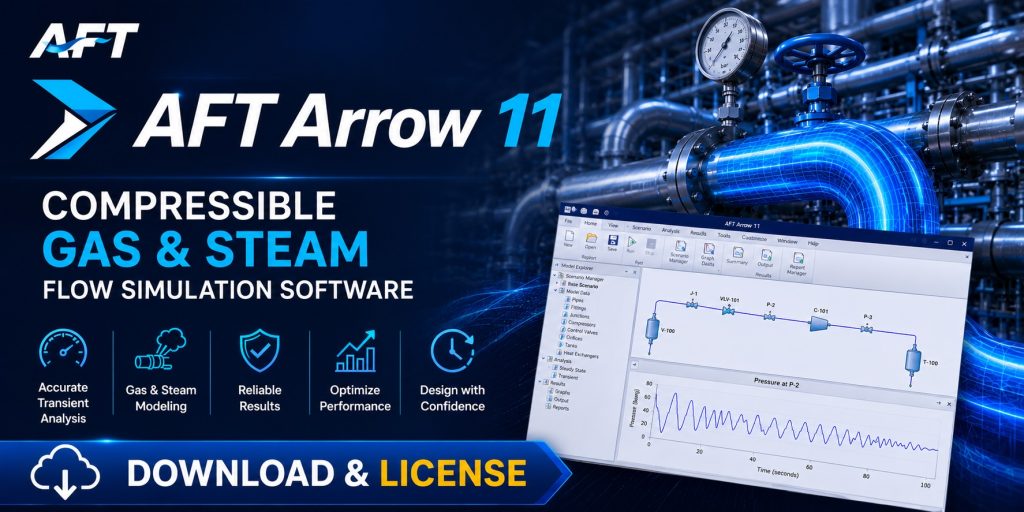
What Is AFT Arrow?
AFT Arrow is a steady-state compressible flow solver built on real-gas equations of state and thermophysical property databases. It handles flow from fully subsonic through sonic choking across pipes, ducts, fittings, valves, orifices, nozzles, fans, blowers, compressors, and heat exchangers — all within a single network model.
Engineers working with natural gas distribution, industrial steam, compressed air, process gases, or industrial ventilation systems need a tool that simultaneously accounts for compressibility effects, temperature and pressure variation along flow paths, and the behavior of rotating equipment and control devices. Arrow addresses all of these within a visual, network-based interface that supports models from a single pipeline up to plant-scale systems with thousands of pipes and junctions.
Trusted by companies including BAE Systems, Mitsubishi, and leading engineering consultancies worldwide, Arrow delivers results that engineers can defend — in design reviews, HAZOP studies, capacity assessments, and energy optimization projects.
Core Capabilities of AFT Arrow 11
Compressible Flow Solver and Heat Transfer
The computational engine at Arrow’s core models gas and steam networks with full compressible-flow physics. It handles subsonic through choked flow through pipes, ducts, fittings, valves, orifices, and nozzles. At every point in the network, pressure, temperature, density, velocity, Mach number, and Reynolds number are tracked simultaneously. Heat transfer along pipes and ducts and across equipment is modeled with temperature-dependent fluid properties. Real-gas property support via equation of state and user-defined fluid capability covers specialty and non-standard gases.
Fans, Blowers, and Compressors
Arrow supports curve-based equipment modeling with variable speed, control points, and series/parallel staging configurations. Delivered flow, head and pressure rise, power draw, and operating efficiency are predicted at each operating point. Engineers can compare scenarios — damper control versus speed control, for instance — to quantify energy savings potential. Operating limits such as approach to choke and insufficient pressure rise are flagged automatically. In one documented project, Arrow modeling showed that VFDs with fully open dampers cut fan power by 25 to 30 percent compared to fixed-speed operation with damper throttling.
Valves, Regulators, and Relief Devices
Control and safety components in compressible systems are sized and analyzed within the same network model. Time- or condition-based control valve actions are supported, with Cv/K versus opening characterization. Choked-flow evaluation is performed through valves, orifices, and restrictions wherever applicable. Pressure-regulating and back-pressure devices maintain stable setpoint control in the simulation. Relief device capacity checks and setpoint trade-offs can be evaluated across multiple scenarios in a single file.
Network Balancing and Flow Distribution
Ensuring correct flow distribution across branching gas and steam networks is one of the most common challenges in system design. Arrow allows engineers to tune dampers, orifices, and regulators to hit target flow and pressure in each branch, assess parallel-path interactions and recirculation, verify minimum delivery at each end user, and compare distribution strategies in terms of both flow balance and energy impact. Color-mapped results and pressure drop breakdowns make bottlenecks immediately visible.
Goal Seek and Control Module (GSC)
The optional GSC module automatically adjusts model inputs to meet engineering goals and constraints. It can solve for fan speed, damper position, regulator setpoints, or nozzle area to hit flow, pressure, velocity, temperature, or Mach number targets. Multiple controllers can be linked with priorities, bounds, and constraints to avoid infeasible solutions, and multi-variable operating conditions can be analyzed to find configurations that satisfy all system requirements simultaneously — without manual iteration.
Extended Time Simulation Module (XTS)
The XTS module extends Arrow’s steady-state engine to simulate time-dependent behavior in compressible networks. Startup and shutdown sequences, purge and pressurization events, and blowdown scenarios with scheduled ramps and triggers can be modeled. Pressure, flow, temperature, and Mach number are tracked as time histories, and the network response can be animated. Equipment staging sequences and control actions can be played out over time to check operating limits during transients and verify recovery to steady targets.
Automated Network Sizing Module (ANS)
The ANS module optimizes pipe and duct sizes and equipment selections to meet all constraints at minimum cost or power. Constraints are applied on flow, pressure, velocity, Mach number, and pressure drop at critical nodes and branches throughout the network. Capital cost, weight, or operating power can be minimized using configurable cost models. Selections can be made from standard size catalogs or continuous diameters with constructability rules applied. The output is a sized bill of materials, and alternatives are compared using the Scenario Manager.
Workflow, Reporting, and Integration
Arrow’s Scenario Manager maintains design alternatives in a single file with inheritance and side-by-side comparison capability. Excel import and export supports model data preparation, results review, and report and graph configuration. Layout imports from PCF files, CAESAR II Neutral files, EPANET, and GIS shapefiles accelerate model creation from existing piping drawings. Design alerts enforce allowable pressures and velocities throughout the model, and color-mapped result visualization highlights problem areas at a glance.
💬 Need a license or have questions? → Message us on Telegram — free consultation, usually reply within a few hours.
What’s New in AFT Arrow 2026
The 2026 release — Arrow 11 — introduces a range of improvements across solver performance, visualization, property modeling, and workflow:
- Optimized solver convergence for large networks exceeding 5,000 pipes and junctions, with meaningfully reduced run times on complex models
- Redesigned color-mapped results display with improved visualization of pressure drop distribution, Mach number, velocity, and isobar lines across the full network diagram
- Expanded NIST REFPROP integration for higher-accuracy real-gas property calculations at elevated temperature and pressure conditions
- Enhanced GSC module with improved multi-variable optimization for complex control systems with interdependent constraints
- Improved PCF and CAESAR II Neutral file import for faster, more reliable layout transfer from piping design tools
- ANS module algorithm improvements for larger design optimization problems with more simultaneous sizing variables
- Advanced support for gas mixtures with variable composition throughout the network, suited to natural gas systems with varying supply quality
- Upgraded reporting templates with customizable formats for project deliverables, design reviews, and regulatory submissions
- Enhanced diagnostic tools for faster identification of bottlenecks, choking locations, and high energy-loss zones
- Improved XTS animation quality for clearer visualization of network response during transient startup, shutdown, and blowdown sequences
Industry Applications
Oil, Gas, and Petrochemical
Gas transmission and distribution companies use Arrow to calculate pressure drop and flow distribution across regional and city gate networks, design pressure reduction stations, analyze gathering system performance in producing fields, and evaluate the capacity impact of adding new consumers to existing infrastructure. Petrochemical plants apply it to fuel gas distribution systems, nitrogen injection networks, instrument gas headers, and process gas piping, verifying adequate pressure delivery under peak demand conditions. In one documented project, a field-correlated Arrow model confirmed 15 MW of additional gas delivery capacity for new customer commitments, avoiding costly infrastructure expansion.
Power Generation
Steam cycle and combined-cycle power plants use Arrow to design high-pressure, intermediate-pressure, and low-pressure steam headers; calculate pressure drop in main steam lines and reheat piping; size control valves and pressure-reducing and desuperheating stations; analyze extraction steam distribution to feedwater heaters; and evaluate steam trap and condensate return systems. The software is also applied to fuel gas supply systems for gas turbines, where pressure adequacy and choking risk must be confirmed across all load conditions.
Aerospace and Defense
Aerospace contractors and research organizations including NASA use Arrow for high-pressure gas system analysis in propellant pressurization lines, test stand supply and purge systems, pneumatic actuation networks, and environmental control systems. The combination of accurate sonic choking prediction and real-gas property support makes it well-suited to the extreme operating conditions found in aerospace fluid systems.
Industrial HVAC and Ventilation
For large commercial buildings, data centers, hospitals, and manufacturing facilities, Arrow models ductwork networks to calculate pressure drop, balance airflow across branches, size fans and blowers, and evaluate the energy impact of different control strategies. At incompressible gas flow velocities typical in HVAC systems, Arrow correctly handles the flow physics while providing the network modeling framework that complex multi-branch duct systems require.
Pharmaceutical and Food and Beverage
Facilities relying on steam sterilization, clean steam distribution, compressed air for manufacturing processes, and purge gas systems use Arrow to verify pressure adequacy, identify supply limitations, and confirm that relief device sizing meets process safety requirements. Compliance with pressure limits across the distribution network can be documented directly from Arrow’s reports and design alert output.
Mining and Minerals Processing
Mining operations that use large compressed air systems for pneumatic conveying, blast hole drilling, and underground ventilation face significant energy costs from air compression. Arrow is used to optimize the distribution network — sizing mains and branches, positioning pressure regulation, and comparing compressor configurations — to reduce leakage impact, maintain adequate delivery pressure at tools and equipment, and minimize compressor power draw.
Water and Wastewater
Aeration blower systems in wastewater treatment plants are a major energy consumer, and Arrow is used to optimize both the blower specification and the distribution header design. In one project, Arrow analysis verified that lowering the pressure setpoint on an existing blower increased delivered airflow to the diffusers and eliminated the need for blower upgrades, saving between $200,000 and $600,000 in capital expenditure.
Engineering Consulting and EPC Firms
Consulting engineers and EPC contractors use Arrow to deliver internationally recognized gas and steam hydraulic analyses on client projects. The software’s combination of accurate physics, configurable reporting, and Excel integration supports deliverables ranging from preliminary sizing calculations to final design documentation, HAZOP-supporting pressure summaries, and relief device sizing packages.
How AFT Arrow Fits Within the Datacor Engineering Suite
Datacor’s pipe flow modeling suite covers distinct simulation domains, and understanding where each tool applies helps engineering teams select the right tool for each task:
- AFT Fathom handles steady-state hydraulics in liquid systems and low-velocity gas applications where compressibility is negligible.
- AFT Arrow covers steady-state compressible flow in gas and steam systems — from subsonic through sonic choking — under normal operating conditions.
- AFT Impulse performs liquid waterhammer analysis for pressure surge events in liquid piping caused by pump trips, valve closures, and similar transients.
- AFT xStream handles compressible transient events in gas and steam systems — pressure wave propagation, shocks, and ESD sequences — when time-accurate dynamic behavior is required.
In practice, Arrow and xStream are frequently used together on the same project: Arrow to establish and verify steady-state operating conditions across operating scenarios, and xStream to analyze dynamic behavior during upsets, emergency shutdowns, and blowdown sequences.
Licensing and Download
AFT Arrow is available as a commercial license from Datacor in single-user and floating network configurations. The optional GSC, XTS, and ANS modules are available separately or in combined packages. For licensing inquiries, procurement support, and download access, contact our team via Telegram:
💬 Need a license or have questions? → Message us on Telegram — free consultation, usually reply within a few hours.
Frequently Asked Questions
What does AFT Arrow calculate?
AFT Arrow calculates steady-state pressure drop and flow distribution in gas and steam piping and ducting systems. At every point in the network, it predicts pressure, temperature, density, velocity, Mach number, and Reynolds number. Engineers use it to design systems, verify sizing, optimize energy use, troubleshoot performance problems, and document compliance with pressure and velocity limits.
How is Arrow different from AFT Fathom?
AFT Fathom is built for liquid systems and low-velocity gas applications where density changes are negligible. AFT Arrow is purpose-built for compressible gas and steam flow — where density, temperature, and velocity change significantly along the flow path and sonic choking is a real possibility. If your system carries natural gas, steam, compressed air, or any process gas at meaningful velocity, Arrow is the correct tool.
Does Arrow handle sonic choking?
Yes. Arrow accurately models sonic choking at all three geometric conditions found in compressible networks — in pipes, through area restrictions, and at junctions — and correctly handles the transition from subsonic to choked flow. Choking locations are flagged in the results so engineers can immediately identify where flow is limited and evaluate design changes.
Can Arrow model liquid systems?
No. Arrow is built on a gas equation of state and is not appropriate for liquid systems. It can, however, model incompressible gas flow at low velocities, covering many industrial HVAC and ventilation applications. For liquid piping systems, use AFT Fathom.
How does Arrow handle real-gas effects and heat transfer?
Real-gas behavior is accounted for through a compressibility factor derived from an equation of state or property database. Heat transfer is modeled along pipes and ducts, across heat exchangers, and through compressors and fans using energy balances at junctions. This enables accurate temperature distribution prediction throughout the network, not just pressure and flow.
What is the practical model size limit in Arrow?
Arrow supports up to 10,000 pipes and 10,000 junctions. In practice, RAM availability typically becomes the constraint before these limits are reached — approximately 32 × (branches + tees)² bytes of memory are required. A model with 1,000 branches and tee junctions needs around 32 MB of RAM. The 2026 release includes solver performance improvements specifically targeting large, complex networks.
Can Arrow model a turbine?
Not directly, but turbines can be represented using a Heat Exchanger junction by entering the turbine’s pressure drop versus flow characteristic and specifying a heat rate out. This captures both the pressure reduction and the enthalpy extraction of the turbine within the network model.
How does Arrow calculate losses at tees and wye fittings?
Arrow uses Idelchik-based correlations that account for the flow split ratio, area changes at the junction, and branch angles to compute pressure losses accurately at tees and wyes. These correlations are valid across a wide range of flow conditions and fitting geometries.
How do I model a relief valve and check for choked flow through restrictions?
Use a Relief Valve junction, which Arrow keeps normally closed and opens automatically when the cracking pressure is reached during the simulation. For choked-flow checks through valves, orifices, or other restrictions, enter the CdA value on the junction’s Optional tab and Arrow will evaluate choking at that location as part of the network solution.
How are gas mixtures created and modeled in Arrow?
Gas mixtures are defined using NIST REFPROP or the optional Chempak database — the standard property database does not support mixture calculations. Once mixtures are defined, they are assigned to source boundaries and Arrow propagates composition through the network using species mass conservation, tracking how mixing at junctions affects downstream fluid properties.
How does Arrow compare to AFT xStream?
AFT Arrow answers the question: under normal steady operating conditions, what are the pressure, temperature, and flow at every point in my gas or steam network? AFT xStream answers a different question: if a disruptive event occurs — a valve closes, a compressor trips, an ESD fires — how does the system respond over time? Both tools are often used together on the same project, with Arrow establishing the baseline operating conditions and xStream analyzing the dynamic response to upset events.
Are the optional modules — GSC, XTS, and ANS — necessary?
The base Arrow license covers pressure drop calculations, network balancing, equipment modeling, and result visualization, which is sufficient for most standard engineering analyses. The GSC module adds value for projects requiring automatic control strategy optimization. The XTS module is needed when startup, shutdown, or blowdown sequence simulation in quasi-transient mode is required. The ANS module applies to projects where automated pipe sizing against multiple constraints is part of the design workflow.
Get a license — free consultation
Pricing depends on version and number of users. Message us on Telegram and we’ll reply with an exact quote — no commitment required.
|
✓
20+ years experience
Software engineers with a long track record
|
⚡
Delivered within 24h
Your license is sent within one business day
|
↩
Money-back guarantee
If the license doesn’t work, we refund in full
|
Usually reply within a few hours — free consultation, no upfront payment