DoCrack_Software Engineering Services

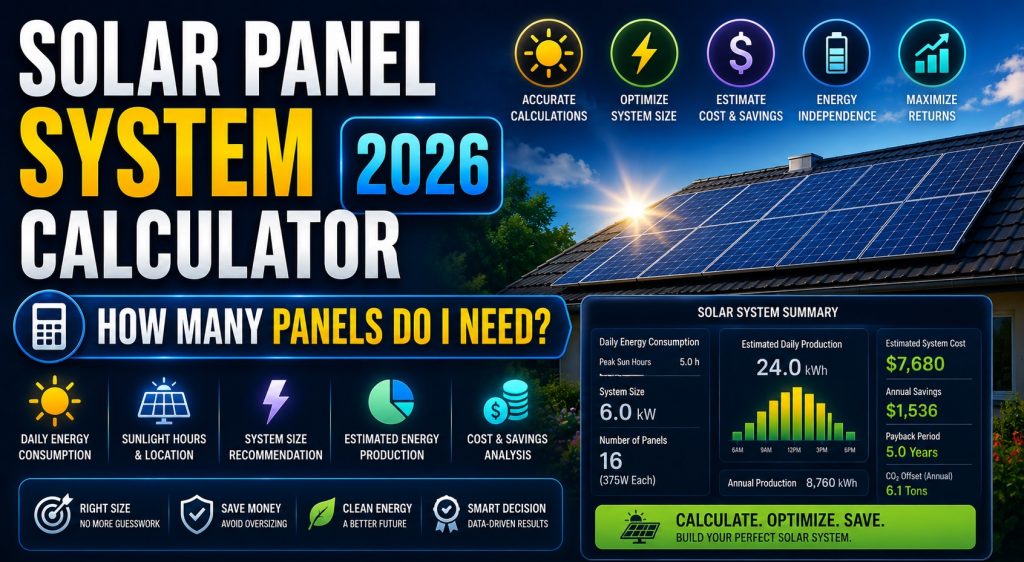
Solar Panel System Calculator 2026 — How Many Panels Do I Need

Solar Panel System Calculator 2026 — How Many Panels Do I Need?


☀️ Free Solar Tool — DoCrack.me

Solar Panel System Calculator 2026 — How Many Panels Do I Need?

Calculate exactly how many solar panels, batteries and inverter capacity you need for your home or business — for any city in the world. Covers off-grid, hybrid and on-grid systems with 80+ city presets and 60+ appliances. Free, no signup.

80+
World cities
60+
Appliance presets
3
System types
Free
No registration

How many solar panels does your home or business actually need?

The number of panels you need depends on four things: your energy consumption, your location’s peak sun hours, the panel wattage you choose, and how much battery autonomy you want during cloudy days. Miss any one of these and you either over-invest or run out of power when you need it most.

This calculator uses real irradiance data for 80+ cities worldwide — from Oslo (2.8 peak sun hours) to Riyadh (6.8 peak sun hours). Enter your monthly kWh from your electricity bill, or use the built-in appliance builder to add devices one by one. The tool outputs panel count, total system kWp, battery capacity in kWh and Ah, inverter sizing, and a 2026 market cost estimate in 14 currencies.

Supports all three system types: off-grid (battery only, no utility connection), hybrid (battery + grid backup), and on-grid (grid-tied, no battery). Each mode outputs different sizing recommendations optimized for that architecture.

ℹ️ Results are estimates for planning purposes. For professional solar design, consult a certified installer with on-site measurements.

What this tool calculates
Number of solar panels needed
Total system capacity (kWp)
Battery capacity (kWh and Ah)
Inverter size recommendation
Off-grid, hybrid & on-grid modes
2026 cost estimate in 14 currencies
Annual CO₂ savings vs grid electricity
60+ appliance presets + print report

docrack.me/solar-tools/solar_calculator.html

Key concepts explained
Off-Grid
100% independent
No utility connection. Requires larger battery bank for cloudy days. Common for remote sites, farms and areas with unreliable grid supply.
Hybrid
Best of both worlds
Battery for outages and peak shaving, grid as backup. Most popular choice for homes and businesses — smaller battery needed vs pure off-grid.
On-Grid
Max ROI, no battery
No battery cost — excess power sells back to the grid. Best ROI where net metering policies are strong (Germany, Australia, many US states).
Peak Sun Hours
The key location factor
Oslo: 2.8h vs Riyadh: 6.8h — the same 10kWp system produces 2.4× more electricity in Riyadh. Location matters more than panel brand.

Common questions

▶ How many solar panels does a typical home need?

A typical 2–3 bedroom home consuming 400–600 kWh/month needs 8–16 panels (450W each) in a sunny location like Dubai or Tehran, or 14–22 panels in a lower-irradiance location like London. The exact number depends on your monthly consumption, city, panel wattage and system efficiency — use the calculator above with your actual electricity bill figure for a precise result.

▶ What is the difference between off-grid and hybrid solar?

Off-grid systems operate with no utility connection at all — 100% of your energy comes from panels and batteries. This requires a larger battery bank (typically 3–5 days of autonomy) to survive cloudy periods. Hybrid systems keep a grid connection as backup, so batteries only need 1–2 days of autonomy — significantly reducing battery cost while still providing outage protection.

▶ How do I find my monthly kWh consumption?

Check your electricity bill — it lists monthly kWh consumed. Use a 3-month average for better accuracy, as consumption varies seasonally. As a guide: studio/1-bed apartment 150–300 kWh/mo, 2–3 bedroom home 350–600 kWh/mo, large family home 700–1,500 kWh/mo, small office or shop 400–900 kWh/mo. If you don’t have a bill, use the appliance builder in the calculator.

▶ What battery capacity do I need for solar?

Battery capacity depends on your daily consumption and how many days of autonomy you want without sun. For a hybrid system covering outages, 1–1.5 days is usually sufficient. For off-grid, 2–3 days is typical. The calculator adjusts battery sizing automatically based on your selected autonomy days and system type. LiFePO4 batteries allow 80–90% depth of discharge vs 50% for lead-acid — fewer kWh of LiFePO4 can replace more kWh of lead-acid.

▶ How do I size my solar inverter?

The inverter must handle your peak instantaneous load, not just average consumption. Add up the wattage of all appliances that could run simultaneously — especially motors (pumps, ACs, fridges) which draw 2–3× their rated wattage on startup. As a rule, size the inverter at 125% of your total peak load. The calculator outputs a recommended inverter size based on your appliance inputs.

Related tools


💰 Solar ROI & Payback Calculator
25-year IRR, NPV, LCOE & payback period

🔋 UPS Runtime Calculator
Battery backup runtime for any load

💾 CCTV Storage Calculator
HDD capacity, RAID config & NVR sizing

🔌 PoE Budget Calculator
Switch power budget for cameras & APs

📡 IP Camera Bandwidth
Network load for multi-camera deployments

Need professional solar design software?
PVsyst, PVcase, Skelion and Archelios — licensed access via DoCrack.me. Contact us on Telegram.
✈ Telegram