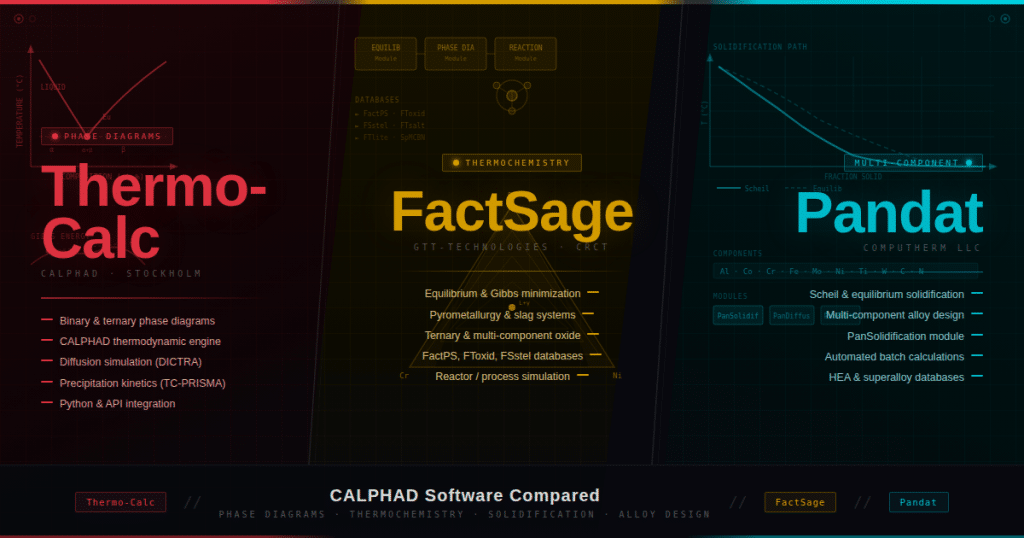
Three platforms dominate commercial CALPHAD computation: Thermo-Calc, FactSage, and Pandat. All three implement the CALPHAD methodology. All three are trusted by researchers and engineers at top materials science institutions globally. All three are expensive. Yet materials scientists who have worked across all three consistently describe them as tools built for different dominant applications — and choosing the wrong platform for your primary use case is a costly mistake, both financially and in learning curve. This comparison maps where each platform genuinely leads, where they overlap, and which one belongs in your workflow.
Quick Decision Guide
Choose Thermo-Calc if:
- Solid-state metallic alloy design is your primary focus (steels, nickel superalloys, titanium, aluminum, HEA)
- You need diffusion simulation (DICTRA) or precipitation kinetics (TC-PRISMA)
- You work in additive manufacturing simulation
- Python automation is central (TC-Python SDK)
- Citation depth matters — 50,000+ peer-reviewed publications
Choose FactSage if:
- Process metallurgy, pyrometallurgy, or slag chemistry is your primary domain
- You work extensively with oxide, salt, or sulfide systems
- Steelmaking or refining process simulation (FactFlow, FactProSim) is needed
- Aluminum electrolysis (Hall-Héroult) or non-ferrous smelting is your application
- Combustion or high-temperature gas chemistry calculations are frequent
Choose Pandat if:
- You prioritize interface intuitiveness and ease of onboarding for new team members
- Additive manufacturing simulation alongside traditional thermodynamics is a focus
- Integration with FEM, phase-field, or AI/ML workflows (PanLink) is needed
- Subscription-based access is preferable to large upfront licensing costs
- Phase-field simulation integrated with CALPHAD thermodynamics (PanPhaseField) is required
The Three Platforms
Thermo-Calc
Developer: Thermo-Calc Software AB (Stockholm, Sweden), founded 1997 as a spin-off from the Royal Institute of Technology (KTH) — the institution where the CALPHAD methodology was substantially co-developed by Bo Sundman, John Ågren, and colleagues from the 1970s onward.
Current version: Thermo-Calc 2026a (released January 21, 2026)
Scale: Used in 60+ countries; cited in over 50,000 peer-reviewed publications and 1,000+ patent applications. By citation count, the most-referenced CALPHAD software in the scientific literature.
Business model: Perpetual license; base software plus databases and modules purchased separately. Annual subscription also available. Commercial licenses typically $20,000+/year for full capability.
Free educational version: Available — limited to systems of 3 or fewer components.
FactSage
Developer: Joint product of Thermfact/CRCT (Centre for Research in Computational Thermochemistry, Polytechnique Montréal, Canada) and GTT-Technologies (Aachen, Germany). Introduced in 2001 as a merger of the Montreal FACT-Win/FAC*T and GTT ChemSage/SOLGASMIX packages.
Lineage: The Montreal group’s database development in extractive metallurgy spans over 50 years. FactSage inherits the deepest institutional knowledge in oxide, salt, and process metallurgy thermodynamics of any commercial platform.
Current version: FactSage 8.4 (released July 2025)
Business model: Perpetual license with dongle or cloud key; annual Maintenance and Service (M&S) for updates and add-ons. FactSageEdu available free for demonstration.
Pandat
Developer: CompuTherm LLC (Madison, Wisconsin, USA), founded 1996 by Professor Y. Austin Chang.
Distinctive origin: Pandat established itself through PanEngine — an automatic equilibrium calculation engine that eliminated the need for user-supplied initial values. This reduced the expertise barrier that prevented many materials engineers from using CALPHAD tools effectively.
Current version: Pandat 2026
Business model: Annual subscription (single-user, non-transferable). Also available through ASM International. More accessible pricing structure than Thermo-Calc.
Free demo: Pandat Demo available with curated demo databases.
Where the Platforms Share Ground
All three perform the same fundamental CALPHAD calculations:
- Phase equilibrium (temperature, pressure, composition) → ✅ All three
- Phase diagrams (binary, ternary, isopleth sections) → ✅ All three
- Scheil-Gulliver solidification simulation → ✅ All three
- Property diagrams (G, H, S, Cp, molar volume) → ✅ All three
- Stable and metastable equilibria → ✅ All three
- Aqueous/corrosion calculations → ✅ All three (with different depth)
At this level, the fundamental distinction is database quality and coverage for your specific material system — not the calculation engine.
The Database Divide — Where the Choice Is Made
Thermo-Calc Database Strengths
Thermo-Calc maintains the broadest portfolio for solid-state metallic alloy systems:
Steel and iron-based systems:
- TCFE15 (2026a) — the most-cited steel thermodynamic database in the materials science literature; the de facto reference for multi-component steel calculations globally
High-temperature metallic alloys:
- TCNI — Nickel-based superalloys (Ni-Al-Co-Cr-Mo-Re-Ru-Ta-Ti-W); used for turbine blade alloy design
- TCTI7 (2026a) — Titanium and TiAl intermetallics; updated for additive manufacturing applications
- TCAL — Aluminum alloys (casting and wrought)
- TCHEA — High entropy alloys; 3d transition metal systems
Specialty systems:
- TCAQ4 (2026a) — Aqueous solutions; fully redesigned with 15 new elements (Zr, Nb, Ti, Pu, Am, and others) for corrosion calculations
- TCOX15 (2026a) — Metal oxide solutions; slags, ceramics, coatings
- TCPMAG3 (2026a) — Permanent magnetic materials (NdFeB, SmCo)
Kinetic databases (for DICTRA and TC-PRISMA): MOBFE9, MOBNI, MOBAL, MOBTI6, MOBHEA4 — each paired with the corresponding thermodynamic database for diffusion and precipitation calculations.
FactSage Database Strengths
FactSage’s depth is in process chemistry systems: oxides, salts, sulfides, and the complex multiphase high-temperature systems of extractive and process metallurgy.
The centerpiece: FToxid FToxid is the industry standard for oxide solution calculations — molten slags, refractories, glasses, ceramics. It describes the FeO-MgO-CaO-SiO₂-Al₂O₃-Cr₂O₃ system and related compositional spaces used in steelmaking slag design, ladle metallurgy, and refractory wear simulation.
The critical technical reason FToxid leads: FactSage implements the Modified Quasichemical Model (MQM) for short-range ordering in molten oxide and salt systems. This model captures the non-random local ordering of atoms in liquid oxide mixtures that simpler random-mixing models miss — physically important for silicate slag systems where SiO₄ tetrahedral networks form. Thermo-Calc and Pandat use different thermodynamic models that are adequate for metallic melts but less suited for this oxide system behavior.
Complete database set:
- FTsalt — Molten salts: chlorides, fluorides, carbonates, nitrates; critical for aluminum smelting, electrochemical processes, nuclear applications
- FThall — The Hall-Héroult aluminum electrolysis process; unique database for primary aluminum production chemistry
- FSstel — Steelmaking database: slag-metal-matte interactions
- GTOx — Oxide systems (GTT-Technologies complement to FToxid)
- FTionx (new in 8.4) — Ionic organic systems
- SGTE(2024) — Updated SGTE alloy database
- SpMCBN — Intermetallics, borides, nitrides, carbides (~100 new ternary systems in 8.4)
Pandat Database Strengths
Pandat covers metallic alloy systems broadly similar to Thermo-Calc in scope:
- Aluminum alloys (casting, wrought; strong in AM context)
- Magnesium alloys
- Nickel-based superalloys
- Titanium alloys
- Steels and Fe-alloys
- Cobalt alloys
- High entropy alloys
Pandat databases are scientifically validated and industry-trusted, but the portfolio is smaller than Thermo-Calc’s, and TCFE and TCNI accumulate more primary literature citations than their Pandat equivalents. For publication-grade work where database credibility is scrutinized by reviewers, this matters.
Kinetic and Simulation Modules
Thermo-Calc: Reference-Level Kinetic Depth
Diffusion Module (DICTRA): DICTRA is the reference software for diffusion-controlled phase transformation simulation — carburization, nitriding, decarburization, interdiffusion in multi-phase systems, homogenization heat treatment. Fully coupled with CALPHAD thermodynamics; no assumptions about equilibrium phase compositions. Used in academic research and industrial R&D for 30+ years.
Precipitation Module (TC-PRISMA): Classical nucleation theory coupled with CALPHAD thermodynamics for multi-component precipitation kinetics during arbitrary heat treatment. Outputs particle size distribution, number density, volume fraction, mean radius vs. time. Used for γ’ in nickel superalloys, NiAl in steels, β’ in aluminum alloys, and many other engineering systems.
Additive Manufacturing Module: Thermal simulation of melt pool behavior during powder bed fusion:
- LPBF (Laser Powder Bed Fusion)
- EBM (Electron Beam Melting) — new in 2026a
- Melt pool geometry, solidification microstructure, composition-dependent thermal properties — all coupled with CALPHAD databases
FactSage: Process Simulation Leader
FactFlow (new in 8.4): Graphical process flowsheet design and optimization — model multi-stage pyrometallurgical processes with mass/energy balances and thermodynamic equilibrium at each unit operation. No coding required.
FactProSim (new in 8.4): EERZ (Effective Equilibrium Reaction Zone) local-equilibrium simulation with Excel integration — ideal for steelmaking converters, electric arc furnaces, ladle metallurgy. Models industrial processes where local equilibrium zones interact without requiring full kinetic description.
ChemApp SDK / ChemSheet: Python and Excel integration for embedding FactSage thermodynamics in external programs and workflows.
FactSage does not have dedicated solid-state diffusion modules (no DICTRA equivalent) or precipitation kinetics modules (no TC-PRISMA equivalent).
Pandat: Broadest Simulation Architecture
Pandat’s 6-module architecture is the most comprehensive simulation framework of the three:
- PanPhaseDiagram — phase equilibria and thermodynamic properties
- PanDiffusion — multicomponent diffusion simulation (DICTRA equivalent)
- PanSolidification — solidification paths, microsegregation, dendrite arm spacing
- PanEvolution — precipitation and recrystallization simulation (TC-PRISMA equivalent)
- PanPhaseField — integrated phase-field simulation with CALPHAD thermodynamics (no equivalent in Thermo-Calc or FactSage)
- PanOptimizer — database parameter optimization
PanLink (Pandat 2026): A unified integration layer connecting Pandat’s CALPHAD calculations with FEM, phase-field, ICME, and AI frameworks in real time. FEM-coupled LPBF simulations (using MOOSE framework), LLM-guided alloy discovery workflows, and phase-field microstructure evolution linked directly to thermodynamic and kinetic databases — all via PanLink. This represents the most ambitious integration architecture of the three platforms.
The PanPhaseField module is Pandat’s unique advantage: direct CALPHAD-coupled phase-field simulation without requiring export/import between separate codes.
Programming and Automation
Thermo-Calc — TC-Python: The most mature and widely documented Python SDK in the CALPHAD space. Full access to all Thermo-Calc calculations; high-throughput compositional screening across thousands of alloy variants; integration with NumPy, Pandas, Matplotlib; active user community with tutorials and examples. TC-Toolbox for MATLAB and TQ-Interface (C/C++/Fortran) also available.
FactSage — ChemApp: SDK for embedding FactSage thermodynamics in external programs. Python interface available. ChemSheet provides Excel integration. Less Python-native than TC-Python, but functional for process simulation automation.
Pandat — PanPython/PandatX/PanLink: PanPython provides Python access to Pandat. PandatX for high-throughput calculations. PanLink (2026) provides the most advanced external coupling architecture — designed for integration with FEM, AI/ML, and ICME frameworks.
Interface and Learning Curve
Thermo-Calc: Dual-mode — Graphical Mode (calculator-based, accessible) and Console Mode (full power). Learning curve moderate; documentation extensive. 2026a added common phase names that reduce interpretation barrier.
FactSage: Module-based suite — each calculation type is a separate application (Equilib, Phase Diagram, Reaction, Predom, EpH). Interface is functional but visually dated. Power users appreciate the depth; new users find the workflow unintuitive. Steepest learning curve of the three.
Pandat: Single integrated workspace. Automatic calculation (no initial values needed). Widely regarded as the most intuitive interface. Shallowest learning curve — the best entry point for CALPHAD newcomers.
Summary Comparison Table
| Capability | Thermo-Calc | FactSage | Pandat |
|---|---|---|---|
| Steel databases | ✅✅ TCFE dominant | ✅ | ✅ |
| Nickel superalloys | ✅✅ TCNI dominant | ✅ | ✅ |
| Titanium alloys | ✅✅ TCTI7 | ✅ | ✅ |
| Oxide/slag chemistry | ✅ TCOX15 | ✅✅ FToxid+MQM dominant | ✅ |
| Molten salts | ✅ | ✅✅ FTsalt | ❌ |
| Steelmaking process sim | ✅ | ✅✅ FactFlow/FactProSim | ✅ |
| Al smelting (Hall-Héroult) | ✅ | ✅✅ FThall unique | ❌ |
| Aqueous/Pourbaix | ✅✅ TCAQ4+Aqueous Calc | ✅ EpH | ✅ |
| Diffusion (DICTRA-level) | ✅✅ DICTRA | ❌ | ✅ PanDiffusion |
| Precipitation kinetics | ✅✅ TC-PRISMA | ❌ | ✅ PanEvolution |
| Additive manufacturing | ✅✅ AM Module (LPBF+EBM) | ❌ | ✅✅ PanSolidification+PanLink |
| Phase-field simulation | ❌ | ❌ | ✅✅ PanPhaseField unique |
| Python automation | ✅✅ TC-Python mature | ✅ ChemApp | ✅ PanPython |
| FEM/AI integration | ✅ External | ✅ ChemApp | ✅✅ PanLink (2026) |
| Interface intuitiveness | ✅✅ | ✅ | ✅✅ |
| Cross-platform (Linux/Mac) | ✅✅ | Windows only | Windows primary |
| Citation count | ✅✅ 50,000+ | ✅✅ Strong | ✅ |
| Free educational version | ✅ | ✅ FactSageEdu | ✅ Demo |
The Multi-Platform Reality
Many leading institutions maintain licenses for more than one platform. The most common configurations:
Thermo-Calc + FactSage: The standard at major metallurgical research groups and steel companies. Thermo-Calc for alloy design and kinetic simulation; FactSage for process metallurgy, slag chemistry, and non-ferrous processing. The combination covers the full workflow from alloy composition to industrial process optimization.
Thermo-Calc + Pandat: Used by groups needing both platforms’ databases or where Pandat’s phase-field and AI/ML integration is needed alongside Thermo-Calc’s kinetic depth.
All three support the .tdb thermodynamic database format to varying degrees, enabling some database portability — though files are not generally interchangeable without conversion.
The Verdict by User Type
The steel researcher: Thermo-Calc (TCFE + MOBFE) for alloy calculations; FactSage (FSstel + FToxid) for process and slag work.
The nickel superalloy engineer: Thermo-Calc (TCNI + MOBNI + TC-PRISMA). No close competitor for γ’/γ” precipitation simulation in complex nickel systems.
The process metallurgist / pyrometallurgist: FactSage. FToxid’s MQM model for oxide systems has no equivalent; FactFlow and FactProSim provide process simulation unavailable elsewhere.
The additive manufacturing researcher: Thermo-Calc AM Module for established CALPHAD-coupled thermal modeling (LPBF + EBM in 2026a); Pandat (PanSolidification + PanLink) if FEM integration and phase-field coupling are central.
The newcomer to CALPHAD: Pandat. Automatic calculation and unified interface deliver results fastest without deep CALPHAD background.
The materials informatics / AI group: Pandat (PanLink 2026) for the most advanced external coupling framework; TC-Python if Python-native Thermo-Calc automation is the priority.
The publication-focused academic: Thermo-Calc. TCFE, TCNI, and TCAL accumulate the most reviewer-recognized citations in the materials science literature.
For Thermo-Calc, FactSage, or Pandat licensing assistance, contact via Telegram: t.me/DoCrackMe
Also see: Thermo-Calc 2026a — What’s New: Complete Release Overview | TC-Python Guide — Automating Thermo-Calc with Python | Thermo-Calc DICTRA — Diffusion Simulation Complete Guide