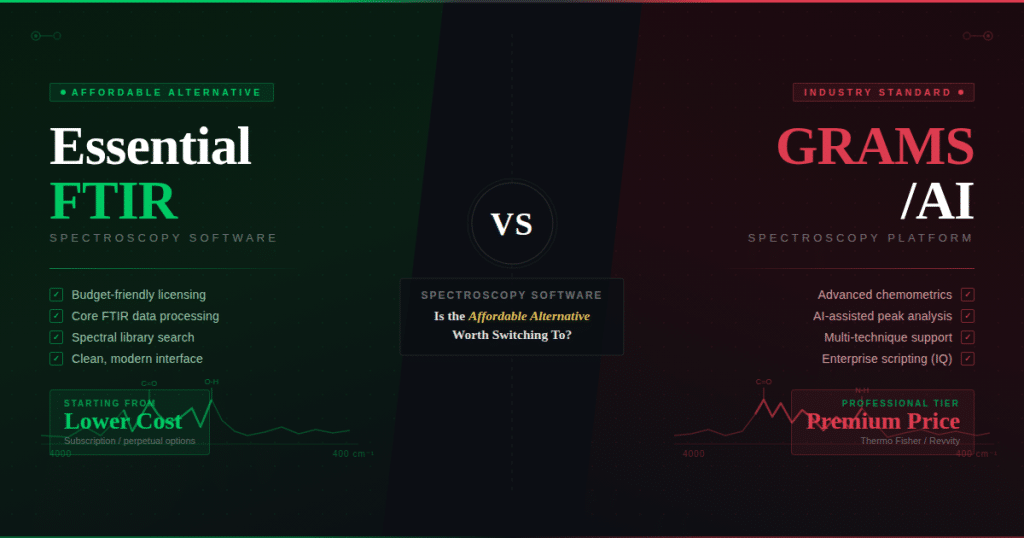
For analytical chemists who have used spectroscopy software for more than a few years, GRAMS is the baseline. Galactic Industries built GRAMS in the 1980s and turned it into the de facto independent analysis platform for FTIR, Raman, NIR, and UV-Vis data — the tool you reached for when you needed to analyze spectra without being locked into a single instrument manufacturer’s software.
Thermo Fisher acquired Galactic, continued GRAMS as GRAMS/AI, and it remains available today. But the pricing has followed the trajectory of most enterprise scientific software — opaque quote-based pricing that many labs describe as difficult to justify, especially for smaller facilities or individual researchers.
Essential FTIR (eFTIR) — and its successor, Peak Spectroscopy Software — emerged directly in response to this gap. Its developer is explicit: Peak is positioned as a low-cost replacement for ThermoFisher GRAMS/AI software. This article examines whether that positioning holds up in practice.
Background: What GRAMS/AI Actually Is
GRAMS/AI was created by Galactic Industries, originally as SpectraCalc and LabCalc in the late 1980s. Galactic also created the .SPC file format — a binary spectral data format that became the de facto industry standard for sharing spectra between instruments and software packages. When Thermo Fisher acquired Galactic, they inherited both the software and the format standard.
GRAMS/AI (version 9.1 is the current release) is a comprehensive spectroscopy platform supporting data from virtually any analytical instrument — FTIR, Raman, NIR, UV-Vis, fluorescence, NMR, and hyphenated techniques (GC-MS, LC-MS, LC-PDA). The “AI” in its name predates machine learning — it originally referred to the analytical intelligence of the processing algorithms, not artificial intelligence in the modern sense.
The GRAMS Suite includes add-on modules:
- GRAMS IQ — chemometric calibration modeling (PLS, PCR, PCA, discriminant analysis)
- GRAMS/3D — real-time visualization of large 3D datasets
- Spectral DB — workgroup spectral database management
- Spectral ID — library search module
- ReactionSleuth — spectroscopic reaction data analysis
The SPC format legacy: Because Galactic created .SPC, virtually all spectroscopy software in the industry reads and writes it. This format compatibility is the foundation on which all commercial spectral library databases are built — when you buy a NICODOM, Sadtler, or Aldrich spectral library, it comes in SPC format precisely because GRAMS established it as the standard.
Background: What Essential FTIR Actually Is
Essential FTIR (eFTIR) was developed by Operant LLC as an independent, affordable spectroscopy analysis platform. Its developer is explicit about the positioning: Essential FTIR’s successor, Peak Spectroscopy Software, is described on peakspectroscopy.com as “a low-cost replacement for ThermoFisher GRAMS/AI software.”
ResearchGate discussions corroborate this positioning in practice — analytical chemists consistently recommend Essential FTIR as the most capable affordable alternative to GRAMS when asked about independent spectral analysis software. One scientist describes it directly: “a terrific alternative to GRAMS (which costs too much IMO).”
Current versions:
- Essential FTIR 3.50 (build 228, November 2025) — the established product
- Peak Spectroscopy Software — the evolution of Essential FTIR, same developer, same core, adding Python numpy format and expanded format support
Both products are maintained and receive updates. The Essential FTIR license is perpetual with no subscription fees. Upgrades are free for licensed users.
Where They Are Functionally Equivalent
The honest starting point: for the most common daily tasks in an analytical spectroscopy lab, Essential FTIR and GRAMS/AI produce identical outcomes.
Multi-format file reading: Both read data from virtually any FTIR, Raman, NIR, and UV-Vis instrument. Essential FTIR reads 70+ formats including Nicolet OMNIC .spa, Perkin-Elmer .sp, Shimadzu .smf, Ocean Optics, Renishaw Raman, and JCAMP-DX. GRAMS/AI uses its SmartConvert technology to recognize hundreds of instrument file formats automatically. For practical purposes, both open your data files.
SPC format as common ground: Both read and write Galactic/GRAMS SPC format — the universal spectral exchange format. When sharing data with colleagues, converting archives, or accessing commercial spectral libraries, both operate on the same format foundation.
Spectral library search: Both search commercial spectral reference databases in SPC format. NICODOM, Sadtler, Aldrich/Sigma-Aldrich, and STJapan libraries work with both platforms. The search algorithm approaches differ slightly, but both return hit lists ranked by spectral similarity.
Core spectral processing: Baseline correction, smoothing, derivatives, spectral subtraction, peak picking, integration, unit conversion (Absorbance/Transmittance, Wavenumbers/Wavelengths) — both platforms implement these standard operations. The implementations differ in interface and workflow details, but the underlying chemistry is the same.
QC Compare / pass-fail testing: Both support comparison of an unknown spectrum against a reference for quality control identity testing, with user-configurable similarity thresholds.
PLS and CLS chemometrics: Both implement Partial Least Squares and Classical Least Squares for quantitative analysis. GRAMS does this through the separate GRAMS IQ module. Essential FTIR includes PLS and CLS in the Complete version license.
Batch processing: Both support automated batch workflows for processing multiple spectra through defined operations without manual intervention.
Where They Genuinely Differ
Pricing — The Central Issue
This is where the comparison becomes stark.
GRAMS/AI requires a quote from Thermo Fisher for pricing — it’s not publicly listed. Based on market reports and lab procurement discussions, the GRAMS Suite with full modules (GRAMS/AI + GRAMS IQ + Spectral DB) represents a significant investment, commonly described as being in the range that makes smaller labs and individual researchers hesitate. The module-based structure means each add-on capability (chemometrics, database management, 3D visualization) has its own separate cost.
Essential FTIR pricing is transparent and substantially lower:
- Viewer version: free (display only, no saving)
- Core version: analytical work at modest cost
- Complete version (all features including PLS/CLS, batch processing, Python): still significantly below GRAMS Suite pricing
- License model: perpetual, no subscription, free upgrades
- 30-day full-featured trial (no credit card required)
For a lab that needs to justify software expenditure to a department head or grant committee, the cost difference alone often makes the decision. Essential FTIR’s perpetual license model — no annual renewal, free upgrades — also has long-term budget advantages over subscription or maintenance-dependent models.
Instrument Breadth and NMR/Hyphenated Techniques
GRAMS/AI explicitly supports data from hyphenated techniques — GC-MS, LC-MS, LC-PDA — and NMR in addition to optical spectroscopy. For a multi-technique analytical laboratory that also handles chromatography-mass spectrometry data, GRAMS provides a single platform across those technique boundaries.
Essential FTIR focuses on optical spectroscopy — FTIR, Raman, NIR, UV-Vis, fluorescence, EELS. It does not handle NMR data or hyphenated chromatography-MS data natively. For labs working exclusively in optical spectroscopy (the majority of FTIR/Raman QC applications), this limitation is irrelevant. For multi-technique analytical departments, it may matter.
Python Scripting
Essential FTIR / Peak includes a built-in Python interpreter as part of the Complete license, enabling custom automation, custom analysis routines, and integration with external tools and data pipelines.
GRAMS/AI offers scripting through its own VBA-like macro language and the GRAMS Suite SDK, which allows developers to create custom GRAMS applications. The GRAMS scripting model is mature and deep for users who know it well, but Python’s broader familiarity in modern scientific computing gives Essential FTIR’s approach a practical advantage for analysts who already work in Python.
User Library Architecture
Essential FTIR’s user library approach is deliberately simple and future-proof: a user library is a folder containing spectral files. Add files to the folder, and they become searchable library entries. Remove files, and they’re gone. The library format is the same as the spectral data files themselves — no proprietary database format, no lock-in.
GRAMS/AI uses Spectral DB for workgroup database management — more structured, with database features for multi-user environments, search by metadata, and database administration. For a large organization managing thousands of reference spectra across multiple users, GRAMS’s Spectral DB provides more database infrastructure. For most labs, Essential FTIR’s folder-based libraries are simpler and carry no risk of data becoming inaccessible if the database software is unavailable.
Historical Data Migration From GRAMS
Existing GRAMS users considering a switch face a practical question: what happens to spectral data currently stored in GRAMS’s proprietary database format?
Essential FTIR directly reads the SPC format that GRAMS uses for spectral data storage. Spectra exported from GRAMS in SPC format are immediately readable in Essential FTIR. For most spectral archives, migration is a matter of exporting from GRAMS in a standard format and opening in Essential FTIR. The GRAMS database structures (Spectral DB, metadata, audit trails) don’t migrate directly — only the spectral data itself transfers cleanly.
The Practical Scenarios
Scenario 1: Industrial QC Lab — Material Identity Testing
A pharmaceutical, polymer, or chemical QC lab running FTIR identity testing on incoming raw materials. The workflow: collect spectrum → baseline correct → library search → QC compare against reference → pass/fail report.
For this workflow, Essential FTIR Complete handles everything GRAMS IQ + GRAMS/AI handles. The file format support covers the instrument data. Library search works with the same commercial databases. QC Compare works identically in concept. Batch processing automates the multi-sample workflow. At a fraction of the cost with no annual renewal.
Scenario 2: Academic Research Lab — Multi-Instrument Data Access
A university research group with FTIR, Raman, and NIR instruments from three different manufacturers, accumulating a spectral archive from multiple studies. Researchers need to open all format types, overlay spectra from different instruments, process them consistently, and export for publication figures.
Essential FTIR’s 70+ format support handles this exactly. The scenario — cross-instrument data access from heterogeneous instruments — is precisely the use case eFTIR was designed for. GRAMS handles the same scenario, but at higher cost. For an academic lab, the price difference is material.
Scenario 3: Government or Forensic Lab — Archive Migration
A forensic laboratory with a decade of spectra in GRAMS/SPC format, moving away from an aging GRAMS installation and needing to continue accessing historical data without renewing the GRAMS license.
Essential FTIR reads SPC directly. Historical spectral data becomes immediately accessible. No format conversion required. The batch processing capability handles verifying large archives efficiently.
Scenario 4: Multi-Technique Industrial Lab — FTIR + GC-MS + NMR
A central analytical services lab handling pharmaceutical impurity analysis across FTIR, GC-MS, LC-MS, and NMR in integrated workflows.
GRAMS/AI has an advantage here — its explicit support for hyphenated techniques and NMR data makes it a genuine single-platform solution across technique boundaries. Essential FTIR would cover the optical spectroscopy portion but require separate tools for MS and NMR data. For this specific scenario, GRAMS’s breadth is meaningful.
Feature Comparison Table
| Feature | Essential FTIR Complete | Peak Spectroscopy | GRAMS/AI Suite |
|---|---|---|---|
| Multi-instrument format support | ✅ 70+ formats | ✅ 70+ formats | ✅ Hundreds (SmartConvert) |
| NMR data | ❌ | ❌ | ✅ |
| GC-MS / LC-MS data | ❌ | ❌ | ✅ |
| Galactic SPC format | ✅ Read/Write | ✅ Read/Write | ✅ Native format |
| JCAMP-DX | ✅ | ✅ | ✅ |
| Library search (SPC/SpectralID) | ✅ | ✅ | ✅ (Spectral ID module) |
| User libraries | Folder-based (simple) | Folder-based | Spectral DB (database) |
| Baseline correction | ✅ | ✅ | ✅ |
| Smoothing (Savitzky-Golay) | ✅ | ✅ | ✅ |
| Derivatives | ✅ | ✅ | ✅ |
| Spectral subtraction | ✅ | ✅ | ✅ |
| Peak picking / Integration | ✅ | ✅ | ✅ |
| QC Compare (pass/fail) | ✅ | ✅ | ✅ |
| PLS chemometrics | ✅ (Complete) | ✅ | ✅ (GRAMS IQ add-on) |
| CLS chemometrics | ✅ (Complete) | ✅ | ✅ (GRAMS IQ add-on) |
| Batch processing | ✅ (Complete) | ✅ | ✅ |
| Python scripting | ✅ (Complete) | ✅ (+ numpy) | Limited (GRAMS macro language) |
| 3D data visualization | ❌ | ❌ | ✅ (GRAMS/3D module) |
| Instrument control | ❌ | ❌ | ✅ (My Instrument plug-in) |
| Multi-user database management | ❌ | ❌ | ✅ (Spectral DB) |
| License model | Perpetual, no renewal | Perpetual, no renewal | Quote-based |
| Relative cost | Low | Low | High |
| Free trial | 30 days (full features) | 30 days | Limited demo |
| Platform | Windows | Windows | Windows |
The Honest Verdict
Essential FTIR is worth switching to if:
- Your work is in optical spectroscopy (FTIR, Raman, NIR, UV-Vis, fluorescence)
- You don’t need NMR or hyphenated technique (GC-MS, LC-MS) data integration
- You need QC identity testing, batch processing, library search, and PLS/CLS
- You find GRAMS pricing difficult to justify for your budget
- You’re starting a new lab or project and evaluating platforms fresh
- You’re a researcher, student, or independent analyst rather than a multi-user enterprise facility
GRAMS/AI retains advantages if:
- Your lab handles NMR or hyphenated technique data alongside optical spectroscopy
- You manage a multi-user spectral database requiring proper database infrastructure
- You rely on GRAMS’s instrument control capability (My Instrument plug-in)
- You need 3D dataset visualization (GRAMS/3D)
- You’re deeply embedded in GRAMS macros and custom GRAMS applications
For the large middle — industrial QC labs running FTIR/Raman identity testing, academic research groups working with multi-instrument spectral archives, forensic labs needing cross-format data access — Essential FTIR Complete does everything GRAMS/AI does for the core spectroscopy workflow at a fraction of the cost. The 30-day trial of the full Complete version is long enough to run your actual QC workflow against it and verify the output matches before any purchase decision.
The SPC format compatibility deserves special emphasis: your existing GRAMS spectral data, and any NICODOM/Aldrich/Sadtler libraries you’ve purchased for GRAMS, work directly in Essential FTIR. The switch doesn’t strand your investment in spectral data or commercial libraries.
Also see: Essential FTIR 3.50 — Complete Feature Guide | FTIR Spectral Library Buyer’s Guide — NICODOM, Aldrich, STJapan Compared | Best Spectroscopy Analysis Software for QC Labs